This is an archival copy of my PhD blog, which was active between 2009–2015. I'm publishing it again as a personal time capsule, but also because I think it's an interesting documentation of the PhD process itself, which might be useful to someone, somewhere. – Chris Marmo, January 2026

The Cost of a PhD

A recent article published on Quartz, titled “Get a PhD – but leave academia as soon as you graduate” has been doing the rounds on twitter. There were a few things that irked me about the piece, despite its seemingly glowing account of undertaking a research degree.

The gist of the article is this: doing a PhD is a terrible financial decision, but worth doing anyway.

On one hand, the article is a positive, bordering on gushing, account of the post-graduate experience.  It’s a defence against economic rationalism in higher education, and a reaffirmation of the transferability of research skills into non-academic work contexts. I agree with all of this, and think these messages should be more widely heard; especially by those who are on the fence about starting a PhD themselves, and even more so (I suspect) by those who have just started. These are a particularly fragile bunch, and ‘stories from the other side’ are vital in keeping motivation and momentum in the early stages of your candidature.

On the other hand, the article acts as a warning against the financial pitfalls of PhD programs, mainly through painting a bleak picture of the academic job market for new graduates. Importantly, it also has a few hidden barbs that are not expanded upon, but which would be key considerations for anyone even contemplating a PhD. The two biggest are in this sentence (emphasis mine):

“After nearly 10 years in graduate school and substantial debt you still end up a part-time or adjunct professor (and still in debt).”

It is these points that I took issue with, primarily because I assume they speak solely to a North American context. I don’t intend this to be a value judgement on conducting a PhD in one country over another; it is simply worth noting though that, in Australia, the UK and elsewhere, the experience of a PhD is very different. Most PhDs are completed within 3 – 4 years in these countries, and in Australia anyway, most are funded by scholarships that are modest at best, but are tax-free. There are no fees associated with the degree, and you are allowed to work up to 10 hours a week on the scholarship, which I did for the first two years of my candidature. It’s certainly true that most people could still earn more money elsewhere, but doing a PhD will hardly “ruin your life”, as the author claims.

I understand that it is not the point of the article to warn off people against starting a PhD. By listing a number of statistics that highlight just how unlikely it is that you’ll come out on top, financially, it’s actually saying that it’s worth it anyway. I wanted to point out, though, that in Australia and other countries around the world, the financial cost of a PhD is significantly less. Indeed,  here in Australia, a few of my colleagues started studying PhDs because the job market was so bad at the time (circa-GFC). In these cases, a research degree was a viable-enough alternative to a commercial job, especially for those coming directly out of their undergraduate studies.

Whilst the article is, on the surface of things,  positive of the PhD experience, it does go to efforts to paint a picture of ‘the noble researcher’ who has chosen to forego the status-quo of the job market in order to engage in a journey of self-fulfilment. This is a dangerous message to send: in doing so, it ignores the actual labour of a research degree (and the value that labour produces).

Research should not be considered a noble pursuit that sits outside the realm of your more run-of-the-mill capital production. Those taking it on should definitely be doing it for the right personal reasons, but they also deserve recognition that their research is a form of work that is valuable in and of itself. It should be rewarded as such, no matter which path they go down afterwards.
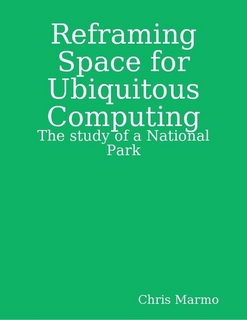
Reframing Space for Ubiquitous Computing

My PhD thesis is now available as a free PDF download (28mb), a free eBook and a print-on-demand book.

With sufficient space between me and the end of the PhD process, I feel like it’s time to share the fruits of 3.5 years with readers of this blog. Whilst there’s still much within the document that I want to distill and communicate here and elsewhere, I think it’s important to provide (open) access to something that was tax-payer funded, and contains content I hope people across a wide range of industries and interests will find useful.

product_thumbnail

The thesis contains about 284 pages of reference-rich research on topics ranging from the temporality of landscapes, infrastructural rhythms, spaces of a natural disaster, and more. It provides a case-study of reflective design and ethnography across multiple sites, and contains lots of meaty detail on digital research methods, and how research can act as prototyping. It also contains detailed scenarios and designs for two conceptual systems aimed at tacit knowledge production in natural environments: Wayfarer, and HABITAT.

If you’re interested in any of the following, then there might be something in here for you:

  • Framing technology as a cultural and social process
  • Investigations into the multi-faceted ways we know and understand our environments
  • Digital ethnography and research methods
  • Reflection through action, research through making
  • Ubiquitous Computing at-large, and it’s related trajectories
  • National Parks, conservation, and the business of managing in these contexts
  • Challenges for government organisations as they enter the messy world of big-data and ubiquitous infrastructure

I’ve made the ebook free to whoever wants it, and have tried to keep the price of the print on demand book as low as possible. Unfortunately, the colour version was far too expensive (in my opinion) to bother with, but if you’re interested in this then please let me know.

Doing this project was one of the most rewarding experiences of my life, and I’m proud to be able to share it here. I’m hoping the ideas strike a chord with some of you.


Headlines

In between various overseas trips and general convalescing at home since I submitted my thesis, I’ve been reading a heap of fiction. For some reason, I just didn’t feel like it during my research, or couldn’t justify the time spent reading non-academic texts.

At the same time, I’ve also tried to keep up the writing habits I’ve formed in the last year: writing in the morning, every day, for a few hours. I’ve definitely taken time away from that, but it would feel like a shame to let that habit slip.

And so, with academic stuff off the radar for a little while yet, I’ve also started to write fiction. While I was traveling, instead of a travel diary I kept a tumblr that I posted 100 word stories to, that were inspired by places and people I met. You can check them out at http://dddrabble.tumblr.com if you’re interested.

A few weeks ago I decided to try my hand at writing something longer than that. I was inspired by the Murmuration Festival, a critical take on the Unmanned Aerial Vehicle, popularly known as the drone. I came across this website somewhere in the depths of twitter, and was inspired to write something.

My short story, ‘Headlines‘, is an exploration of a future where journalists primarily use drones to cover news events. It has elements of surveillance culture, big-data, cyber espionage and digital activism.

It was fun to write, and even has a timely/opportunistic reference to the NSA (hi guys).

I’m working on another story now, and will definitely try to get that one published somewhere too. Ultimately though, this is all in service of making the wait for the verdict a bit easier.

Submission

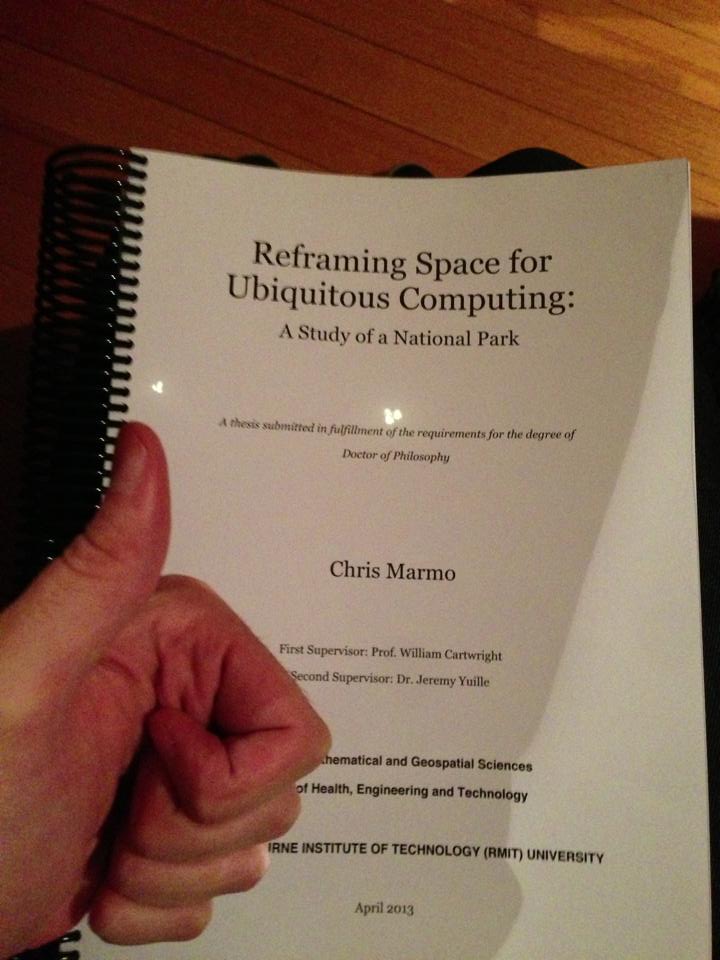
Two weeks ago, I handed in my thesis for examination. In Australia, we call this event the ‘submission’, where three heavy, bounded copies of your work are entered into all manner of administrivia before being distributed to two anonymous examiners, and a third if those two disagree.

There’s no defence as such; just a presentation to a panel of academics, usually from your own department, relaying the main achievements and where any concerns (typically the students) are allayed.

The final title was “Reframing Space for Ubiquitous Computing: A Study of a National Park”. In hindsight, I would have subtitled it differently, going for something like ‘The Case of a National Park” to make it sound like there was more of a story inside.

I was satisfied with it in the end, but need more space between then and now before commenting on the work any further. It was a truly fulfilling experience, but an exhausting one, and I plan on taking my time savouring its completion and recovering from it. I’ve applied for a publication scholarship from RMIT to turn some of the research into a more disseminate-able form, and will hopefully spend some of the next three months working on a couple of journal articles. That will distract me from the long wait for my examination results.

After that, I’ll publish excerpts from my thesis here, and offer the full thing for download. I’m inspired by Philipp Vannini’s Ferry Tales, and want to start experimenting with different ways of presenting and communicating ethnography online and in an interactive way.

For now, i’ll be enjoying reading this, this, this and this on various beaches.


A New Abstract

The last 6 months have been a whirlwind of writing, reframing, designing, and presenting as the deadline for my thesis submission approaches. I haven’t posted any of this new work here as it’s been such a dynamic process that I haven’t wanted to document it in public. However, a few weeks ago I was forced to finally update my abstract to reflect what the final incarnation of this research is likely to be. I’ve updated the abstract page, but to save you a click, here it is:

Ubiquitous Computing is a project within human-computer interaction that aims to embed computers into everyday spaces. As computing has moved away from desktop paradigms and is increasingly designed to operate ‘in the world’, the practice of ubiquitous computing has become heavily concerned with issues around space and place; particularly, with how technology fits in the relationship between people, space, and the understandings that bind them. Given the wider range of social and cultural contexts computational devices find themselves in, understanding the existing relationships between humans and their environments has become increasingly important to designers of technology. However, most of this research is centred around urban computing, conducted within cities, or focused on the mobility of urban dwellers. Indeed, little focus has been given to ubiquitous computing for non-urban environments.

This research expands the understanding of the relationship between technology and environmental understanding for ubiquitous computing. Through the case study of a national park, this thesis proposes new ways of thinking about designing technology that plays a role in the production of environmental understanding that moves beyond the typical focus on urban centres and mobility. It does so by drawing upon relational notions of space and understanding from cultural geography; examining how meaning of the world is socially and culturally produced and constructed. Building on this foundation, two multi-sited ethnographic studies with a state government organisation, Parks Victoria, are presented that demonstrate various productions of environmental knowledge in practice.

Based on analysis of these studies, a series of design principles are presented that reframe space and environmental understanding as emergent and seasonal processes. Drawing on these design principles, two design concepts are presented that are envisioned for use within Parks Victoria: Habitat, a location-based platform for tacit knowledge, and Wayfarer, a visualisation and narrative tool for situated understandings. A reflection on these related pieces of research will then serve to highlight new, practical directions for further work in ubiquitous computing in a non-urban context.

This is approximately the 10th version of my thesis abstract, and no doubt it will be tweaked even further in the coming weeks.There’s 30 days or so before my thesis is due, and I’m exciting about some of the new developments in it. Once I catch my breath I’ll be sure to post snippets of individual chapters here.

Head down

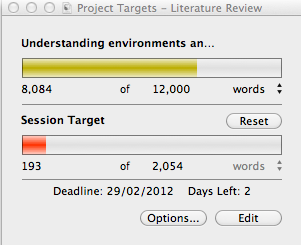
This is a quick post to break the drought here, and to let the world know that I have been working. The above picture is from Scrivener – my writing program of choice – showing the word target for my literature review. Writing this has been enjoyable so far (sort of), and has caused me to rethink and rework much of the approach I’m taking to the thesis overall. I’ve been doing lots of reading on human geography, and that topic will take up much of the remaining 4000 words.

The general gist of the literature review: Spatial concerns like distance, time and “place” (the social interpretation of a location) have been seen as things to overcome and solve through technology. But what if (like in human geography), we saw them not as something to solve, but as things to embrace? How does that change the way we approach new technologies?

Also, I find it pretty amusing that a 12,000 word document no longer scares me.

Emerging outlines

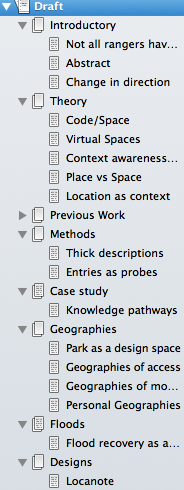
As an activity today I went through this blog and conducted a card sort on the posts. What emerged from it was a rough outline of my overall thesis (and the realisation that I’ve written many more words than I had originally thought). There is a lot of manipulation to get these words into a submittable form, but this quick glance through has netted me close to 15,000 of them. This is minus any of the notebook content and thinking I’ve done, my notational velocity library, formal papers (6+), and various documents written around my case study and methods.

I’m feeling better about finishing by September now. More importantly, this exercise has given me the start of a document that has an concrete outline, and will slowly evolve into a finished thesis.

Notes

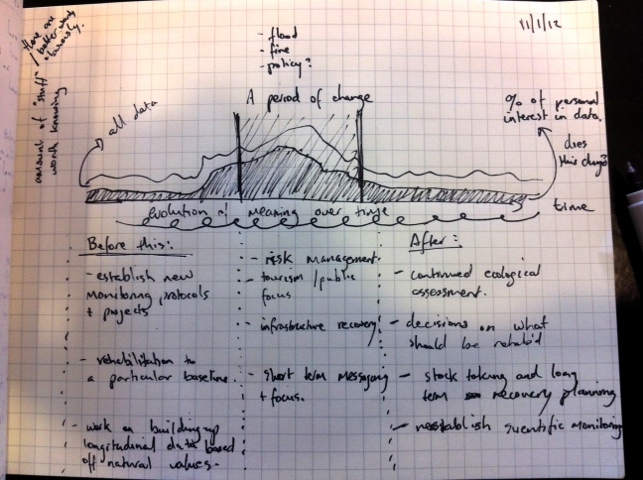
I’m increasingly relying on my notebook to test out ideas and document progress. In the last 3 months, there’s been about 100 pages of content similar to this: trying different ways of analyzing data, and prototyping chapters. It feels much less formal than this blog, but today I was suddenly struck with the realization that if this notebook was lost, so would the majority of the most recent thoughts on my phd.

So I’ll include a picture of important ones here, every so often. Beyond that, I’ll let the note speak for itself.

20120111-134859.jpg

Another refresh

It’s a common story that the focus of a PhD changes dramatically as you progress through it. In almost two years I think I’ve written about 10 different abstracts, all with some kind of common thread but with decidedly different implications for the activities and outcomes of the project. In that spirit, I’d like to post another abstract!

This one I think pulls together a lot of the thoughts I’ve had over the last few months and gives me a bit more direction (which hopefully will translate in to more frequent posts here). No doubt there’ll be more versions, but for now this is what is making sense to me.

This thesis expands the understanding of the relationships between technology, people and environmental knowledge.

Our understanding of the environments we inhabit have always been socially grounded; the interactions we have with a space define it, and the meaning we construct about these places is socially embedded. As technology becomes increasingly mobile and ubiquitous, it too has become socially embedded. People are connecting across time and space, and real-time access to vast amounts of information are changing the ways we interact with the world in tangible ways. The spaces we inhabit are at once physical, social and digital – they are blended.
There has been much research into the potential for technology to facilitate collaboration and co-presence, and around the ways technology use and infrastructure influences our perceptions of and movements in the world. However, there has been little that looks at the combination of both: how we can co-create an understanding of our environment that crosses the seams between physical and digital spaces.

Through an ethnographic study of rangers in a national park, this thesis will build upon the current research around environmental knowing and its implications for ubiquitous and mobile computing. It will provide exploratory designs for two different systems that demonstrate blended space for the purpose of sharing local knowledge about the environment, and will discuss the potential for digital space to enrich this knowledge. This thesis argues that by decreasing the divide between physical and digital spaces, we can facilitate and enrich our understanding of the locations we interact with.

Thoughts appreciated!

Designing a case study

When I started my research, I didn’t fully understand how lucky I was to have an industry partner attached to the project. As part of an existing Design Research Institute project, my PhD position was essentially like a normal full-time position, with a project ready to kick off; all I did was slot in and get started. Which, of course, sounds much easier than it was.

I’m now about 50% through my allotted time, and about one month in to my field work. The idea all along, even in the very first version of my research proposal, was to base my research around case studies. This isn’t surprising, and is still true; however, my idea of what a case study is has changed significantly. When I first started, I understood the entire geographical region of a park to be my case study. “Wilson’s Promontory National Park” was going to be a chapter in my thesis, and the unit of measurement would have been people’s behaviour in and around that location. I thought that simply having an industry partner meant I could tick the case study box.

Based on the handful of interviews I’ve done so far I now realise that just as much happens outside a park than in it, and that narrowing the case study to a geographical location would ignore the thread of knowledge that goes through the entire organisation, and is not just situated in the park. Whilst locations (and people’s understandings of them) are still the core of my research, the actual frame through which I analyse that has changed. My case studies are no longer just geographical locations, but are ecological projects that start and end outside of the park.

Parks and people

Parks Victoria is a large organisation with many different focuses, summarised up by the phrase “Healthy parks, Healthy people”. This suggests two primary facets to park management: the ecological integrity of the park, and the focus on the public’s enjoyment of these natural environments. Whilst these values appear to be at odds with each other at times, they are also closely intertwined; people cannot enjoy parks if the ecology is not managed correctly, and tourism provides valuable financial support to allow purely ecological projects to continue. The emotional connections people establish with parks similarly gives Parks Victoria added weight when it comes to gaining clout with the state government. People are passionate about these places, and this translates into votes.

That aside, my research is focused on the ecological management of parks, particularly in relation to the sharing and generation of tacit knowledge about bushfire prevention, management and recovery. Internally, this kind of management falls under the umbrella of “natural values”, a term that describes the ecological management priorities in and around a given park.

Natural values management

The organisation has a set of values that dictates the kinds of ecological management projects that are planned and carried out. These values act as a means to prioritise the management activities in a park, and may be something like:

Ensure endagered species and their environments are protected.

From this value, the management team – working with park rangers – plan projects to achieve and satisfy that goal. These projects may be to do with monitoring of species populations or the control of noxious flora that could jeopardise the species’ habitat. Once a project is decided upon, a team of people design and plan the research project, collaborating withrangers to choose practical and appropriate sites, and sometimes with contractors and other groups to carry out the actual research. Analysis is then fed back into the organisation and contributes to long term trend mapping.

It is these research projects that provide a common thread throughout the whole organisation, and I now plan on following two of these projects as case studies. One project will be based at Wilson’s Prom, whilst it’s looking like the other will be in the Otways National Park.

The thread between locations, people and space

By having natural values management projects as broader case studies, I will hopefully have a more complete picture of what happens during park manangement, and this picture will not be limited simply to a geographical location. Whilst the way people relate to locations is still the core of my research, having an organisation wide thread to follow will allow me to:

  • Understand individual rangers and scientists views of the locations they manage, in the shared context of an NVM project.
  • Understand how different people interpret the same space; do rangers and scientists have different views on locations, and what implications does this have when they come to work on the same project?
  • Examine how these differences play out in a project, and what it may mean for the design of a context-sensitive knowledge tool.

Similarly, by having two sites of research, I will be able to:

  • Compare the kinds of knowledge being generated and used across similar projects, but different locations.
  • Generate a set of design principles that could be applied across more varied environments. Whilst parks are still the focus, having multiple locations will make the principles for situated and located sense-making more robust.

Implications for design

From an analysis of qualitative data around these case studies I hope to establish some broad design principles that I can use to come up with a location-based, multi-faceted and in-situ knowledge service. I hope this exercise will contribute to the broader ubiquitous computing literature, and I’m also hoping to develop some basic working prototypes to be used and tested in the field. I’m going to WWDC in June, and will use what I learn there to do some rapid prototyping (and check out San Francisco, of course).

This is not an essay

Obviously this isn’t an essay on knowledge spaces, as I had previously posted. Given recent flooding at Wilson’s Prom – my primary case study – I had to refocus on finding another case study site last week. The park received 500mm of rain in one 24 hour period, and most of the infrastructure in the park has been damaged or washed away. Access is limited to the park, and the staff based there have been shifted away from their usual roles – everyone is focused on recovering the park as quickly as possible, and are now working outside the park until work facilities have been restored. This post is a step towards some kind of contingency plan, and we’re all hoping The Prom will recover quickly.