This is an archival copy of my PhD blog, which was active between 2009–2015. I'm publishing it again as a personal time capsule, but also because I think it's an interesting documentation of the PhD process itself, which might be useful to someone, somewhere. – Chris Marmo, January 2026

Head down

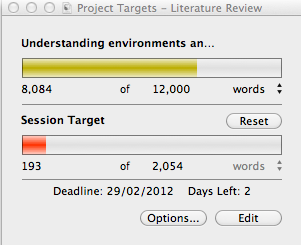
This is a quick post to break the drought here, and to let the world know that I have been working. The above picture is from Scrivener – my writing program of choice – showing the word target for my literature review. Writing this has been enjoyable so far (sort of), and has caused me to rethink and rework much of the approach I’m taking to the thesis overall. I’ve been doing lots of reading on human geography, and that topic will take up much of the remaining 4000 words.

The general gist of the literature review: Spatial concerns like distance, time and “place” (the social interpretation of a location) have been seen as things to overcome and solve through technology. But what if (like in human geography), we saw them not as something to solve, but as things to embrace? How does that change the way we approach new technologies?

Also, I find it pretty amusing that a 12,000 word document no longer scares me.

Flood Recovery as a Space

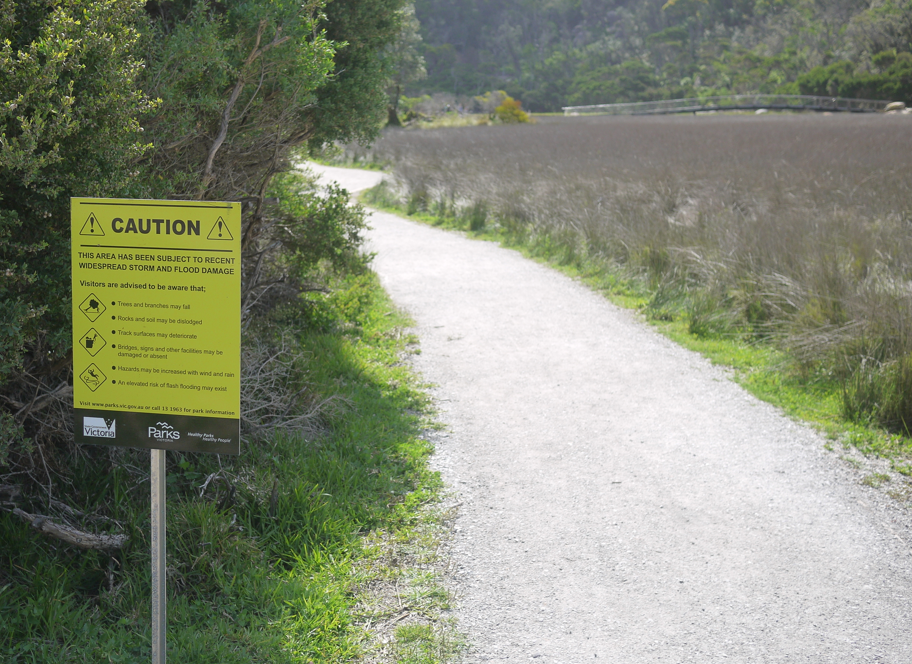
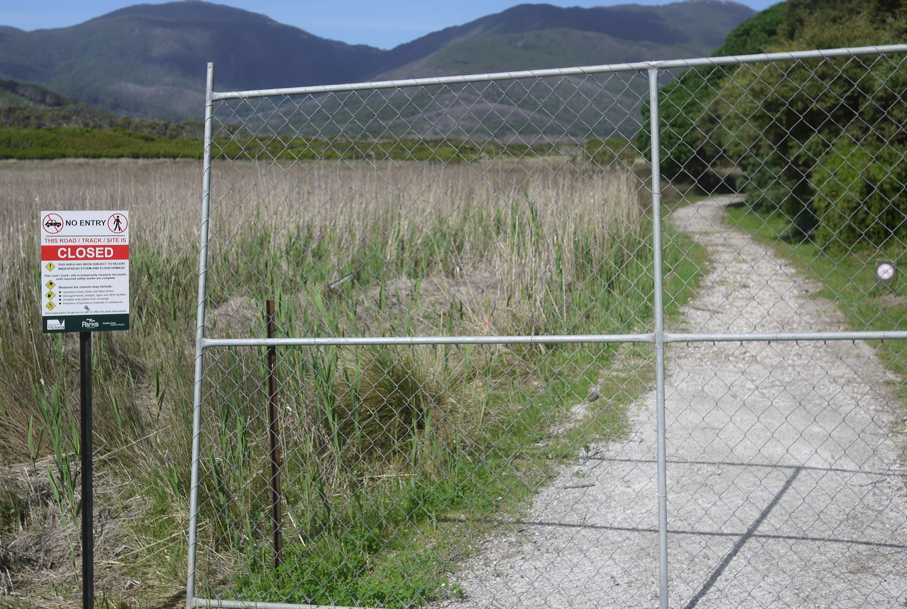
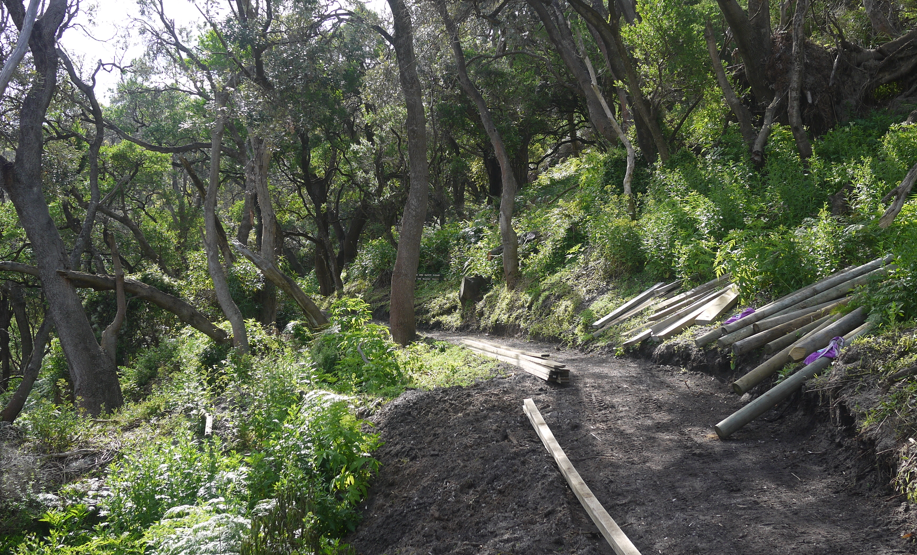
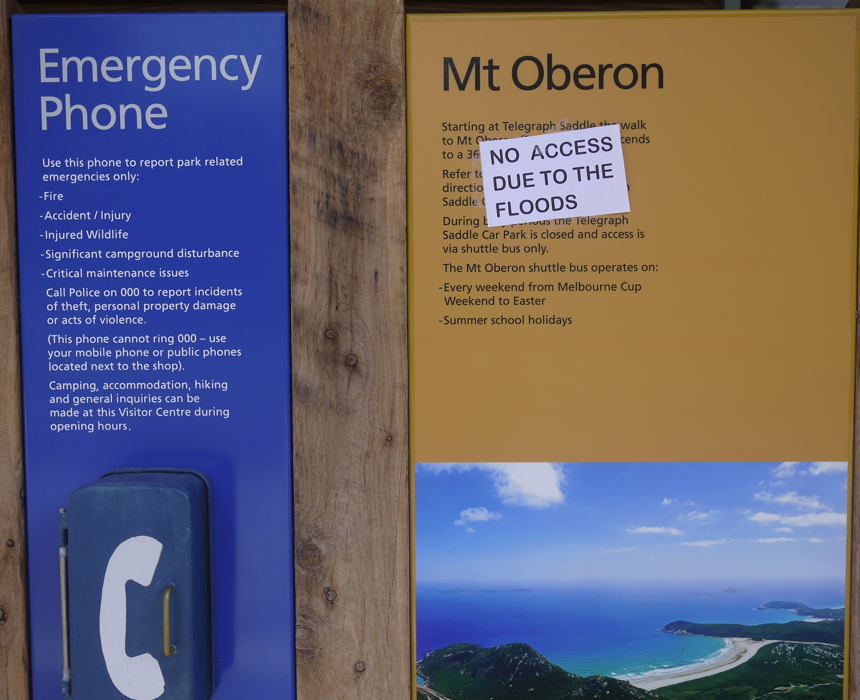
Whilst the park is open to visitors, issues of access and accessibility are still persistent. These images above are taken mainly in “tourist” areas, with the signage communicating to the public. However, the issues are present for everyone: people can’t get to where they were able to previously.

How is this effecting the information being collected in the park? Monitoring equipment has been disrupted, and simply can’t be gotten to. At the same time, the focus of work has shifted from ecological management to getting visitor infrastructure back up to scratch. The flood has been a hugely disruptive event that has changed how people (both public + rangers) interact with the park – and therefore, their understanding of it.

The space of a flood recovery is very different to that of normal park management. The rangers are still in that space.

Designing a case study

When I started my research, I didn’t fully understand how lucky I was to have an industry partner attached to the project. As part of an existing Design Research Institute project, my PhD position was essentially like a normal full-time position, with a project ready to kick off; all I did was slot in and get started. Which, of course, sounds much easier than it was.

I’m now about 50% through my allotted time, and about one month in to my field work. The idea all along, even in the very first version of my research proposal, was to base my research around case studies. This isn’t surprising, and is still true; however, my idea of what a case study is has changed significantly. When I first started, I understood the entire geographical region of a park to be my case study. “Wilson’s Promontory National Park” was going to be a chapter in my thesis, and the unit of measurement would have been people’s behaviour in and around that location. I thought that simply having an industry partner meant I could tick the case study box.

Based on the handful of interviews I’ve done so far I now realise that just as much happens outside a park than in it, and that narrowing the case study to a geographical location would ignore the thread of knowledge that goes through the entire organisation, and is not just situated in the park. Whilst locations (and people’s understandings of them) are still the core of my research, the actual frame through which I analyse that has changed. My case studies are no longer just geographical locations, but are ecological projects that start and end outside of the park.

Parks and people

Parks Victoria is a large organisation with many different focuses, summarised up by the phrase “Healthy parks, Healthy people”. This suggests two primary facets to park management: the ecological integrity of the park, and the focus on the public’s enjoyment of these natural environments. Whilst these values appear to be at odds with each other at times, they are also closely intertwined; people cannot enjoy parks if the ecology is not managed correctly, and tourism provides valuable financial support to allow purely ecological projects to continue. The emotional connections people establish with parks similarly gives Parks Victoria added weight when it comes to gaining clout with the state government. People are passionate about these places, and this translates into votes.

That aside, my research is focused on the ecological management of parks, particularly in relation to the sharing and generation of tacit knowledge about bushfire prevention, management and recovery. Internally, this kind of management falls under the umbrella of “natural values”, a term that describes the ecological management priorities in and around a given park.

Natural values management

The organisation has a set of values that dictates the kinds of ecological management projects that are planned and carried out. These values act as a means to prioritise the management activities in a park, and may be something like:

Ensure endagered species and their environments are protected.

From this value, the management team – working with park rangers – plan projects to achieve and satisfy that goal. These projects may be to do with monitoring of species populations or the control of noxious flora that could jeopardise the species’ habitat. Once a project is decided upon, a team of people design and plan the research project, collaborating withrangers to choose practical and appropriate sites, and sometimes with contractors and other groups to carry out the actual research. Analysis is then fed back into the organisation and contributes to long term trend mapping.

It is these research projects that provide a common thread throughout the whole organisation, and I now plan on following two of these projects as case studies. One project will be based at Wilson’s Prom, whilst it’s looking like the other will be in the Otways National Park.

The thread between locations, people and space

By having natural values management projects as broader case studies, I will hopefully have a more complete picture of what happens during park manangement, and this picture will not be limited simply to a geographical location. Whilst the way people relate to locations is still the core of my research, having an organisation wide thread to follow will allow me to:

  • Understand individual rangers and scientists views of the locations they manage, in the shared context of an NVM project.
  • Understand how different people interpret the same space; do rangers and scientists have different views on locations, and what implications does this have when they come to work on the same project?
  • Examine how these differences play out in a project, and what it may mean for the design of a context-sensitive knowledge tool.

Similarly, by having two sites of research, I will be able to:

  • Compare the kinds of knowledge being generated and used across similar projects, but different locations.
  • Generate a set of design principles that could be applied across more varied environments. Whilst parks are still the focus, having multiple locations will make the principles for situated and located sense-making more robust.

Implications for design

From an analysis of qualitative data around these case studies I hope to establish some broad design principles that I can use to come up with a location-based, multi-faceted and in-situ knowledge service. I hope this exercise will contribute to the broader ubiquitous computing literature, and I’m also hoping to develop some basic working prototypes to be used and tested in the field. I’m going to WWDC in June, and will use what I learn there to do some rapid prototyping (and check out San Francisco, of course).

This is not an essay

Obviously this isn’t an essay on knowledge spaces, as I had previously posted. Given recent flooding at Wilson’s Prom – my primary case study – I had to refocus on finding another case study site last week. The park received 500mm of rain in one 24 hour period, and most of the infrastructure in the park has been damaged or washed away. Access is limited to the park, and the staff based there have been shifted away from their usual roles – everyone is focused on recovering the park as quickly as possible, and are now working outside the park until work facilities have been restored. This post is a step towards some kind of contingency plan, and we’re all hoping The Prom will recover quickly.

Not all rangers have beards

This week I went to a seminar that focused on communicating research. It was a pre-requisite for entering the 3-minute thesis competition, which seems like a mini-TED for research students with a time limit. I don’t know if I’ll enter the competition (although there’s some impressive cash amounts up for grabs), but I’ll definitely be using some lessons from the seminar in my writing. The main thing I took away from it was the importance of having a story around the research, and allowing people to feel an emotional connection to it. This post is my attempt to add that story.

The story of National Parks

People love national parks – they are places families go, where summers are spent, and where kids grow up. They provide an escape from architected office buildings, armpits on crowded trains and suburban peak hour traffic. The air is fresh, and the landscape is rejuvenating.

When such a place is ravaged by fire, those that have developed a connection to it feel violated – it’s as if their house has been burgled. An uninvited stranger crashes through, sweeping away the things they feel that connection with and leaving a shell. Like being burgled, it’s not just the memory of absent things that lingers – it’s the thought that the once unquestionably secure destination is no longer so. We never feel completely at home again.

On top of this, fire is devastating for the ecology of a park. When controlled, it is a necessary part of managing the landscape. When unplanned, it can permanently damage the land and the lives of the creatures that inhabit it.

It’s important that we do all we can to manage the risks of unplanned fire.

Some rangers live in the city, and not all of them have beards.

Luckily, there are people whose job it is to do this. Parks rangers are often based in the same park for many years, and over this time they learn to recognise signs in the environment that warn them that a fire may get beyond control. They have sensors that tell them about fuel levels and soil moisture, but, like most of us, they also rely on their instinct, or their tacit knowledge.

At the same time, back in the city, there are people who don’t wear khaki shorts who play just as important a role in the park. These people keep track of ecological research about parks, plan studies to discover populations of rodents, and keep tabs on the regrowth of native scrub. They also coordinate external groups of volunteers and researchers who contribute information back to the organisation, and provide those “on the ground” with the data they need to make decisions.

Both types of park ranger contribute to keeping the ecological balance necessary for healthy parks, and healthy people. However, both are struggling under the sheer weight of data available to them. Relevant scientific studies get lost in filing cabinets, and even when they are accessible they are not easily integrated into management plans. Similarly, rich, tacit knowledge is not accessible to other staff, and is lost completely when rangers retire or move on.

So on one hand, they need help dealing with the sheer quantity of data available to them. On the other, there’s a need to capture the rich, experiential knowledge that can help bridge the gap between the numbers, the park and the people in it.

A consensus of interpretation

The one common element to all of this data, information and knowledge is location. Reports are about regions in a park, rangers visit specific points and extrapolate their assessment to broader areas, and remote sensors are scattered in the park, forming a virtual topography of data on top of the natural environment.

Given the located and situated aspect of park management, it makes sense to give rangers tools to view information through the lens of location. It makes even more sense to give them tools through which they can record, interpret and use information about these places in the places themselves.

There are bodies of research that indicate that information makes more sense to us, and is more useful, when presented in the same context in which it is to be used. Facilitating the exploration of information in the places they are about can lead to the generation of better quality understandings of this information.

Similarly, we want to allow rangers to add their own meaning on top of this raw information, and to share and evolve that with other rangers. There’s also research, and indeed entire disciplines, that focus on computer supported collaborative work and show that the shared interpretation of data leads to better outcomes.

In the cloud

What this research plans to do is allow rangers to explore and interpret data about places, through mobile technology, in those very same places. Similarly, we want to allow rangers to share their interpretations of data with other rangers. By interacting with information and each other through mobile technology, rangers will ultimately form a human filtered and rich-in-quality body of knowledge that lives “in the clouds” above parks.

By giving rangers better access to the most important knowledge about parks, and particularly knowledge around fire management, they will be better equipped to manage and prevent unplanned fires. Uninterrupted, families can continue to form memories tinged with green, native flora and fauna can continue to flourish, and rangers can continue living in the country or in the city and with full freedom of choice around facial hair.

/eom

Well, that’s my first shot at adding some kind of narrative around what I’m doing. I’m in the process of applying to a doctoral consortium, and think this will really help me add context and reason to the more academic details. Thanks Inger!
Context: awareness vs sensitivity

I’ve been doing a lot of reading and writing around context awareness the past couple of months – so much so that I changed the subtitle of this site to include it. It’s safe to say that the notion of this kind of awareness completely captured my imagination, or at the very least, led me to line up a whole stack of journal articles and books on the topic.

With the plethora of location-based applications appearing on various mobile platforms, the ubiquitous nature of geo-tagged data and the popular medias seemingly undying thirst for the latest tech-innovation, location enjoyed a pretty good ride in 2010. Starting at location as a focus of research (as I did), it’s not long before you realise that a coordinate is just one piece of metadata that can describe context, and it seems like a natural progression to begin thinking about broader notions of the term.

The next thing you realise after reading all about the current attempts at context-awareness is that, well, they suck fail to be all that useful.

There are many very intelligent systems-based frameworks for building an architecture of sensors that can detect where and what you’re doing, and very detailed examples of software implementations that aim to interpret this sensor-based data to assist their users. It’s not that these frameworks and implementations are poor or under-thought, it’s simply that the technology isn’t there yet, and our expectations are too high.

Great Expectations

This isn’t our fault though – the term “aware” is loaded with expectation. It immediately conjures notions of Asimov-type robots that basically act and understand as we do – of computational uber-humans superior to us in every way – and ones that we will either grow to love or fear completely.

The problem is hinted at above – in the interpretation. Whilst we might have sensors that can pinpoint you on a map, know who you’re with, whether you’re talking or not, walking or not, whether you’re standing, sitting, or lying down, the problem lies in the translation of this sensorial information into meaningful, and accurate interpretations for software to use.

The optimist and sci-fi fan in me thinks that, one day, we will see a convergence of sensor technology and artificial intelligence that will provide useful scenarios to people. You might argue this happens already – a pilot’s cockpit springs to mind. But the fact remains that the detection of meaningful, dynamic and social context is a long way off.

Context is socially constructed

I’m working on a longer article on this at the moment, so I won’t go into too much detail. It is worth noting however, that whilst the cockpit of a plane is a highly controlled environment where all variables are know, much of what we would define as context is socially constructed. That is, its existence is fleeting, and only arises out of interaction between people, objects and the environment.

Whilst we may be able to detect your location fairly accurately, the context to your presence there is very difficult to detect. Test this next time you’re in a cafe – note all the different activities that are taking place there. The animated conversations, the quiet reading, the anxious waiting, the scurrying (or bored?) staff. For each of these actors, the place holds a completely different meaning for them – and hence, a different context.

Context Sensitivity

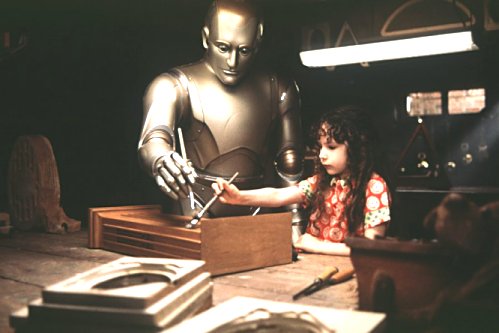
So if we can’t rely on technology to sense and interpret that kind of context, then what can we do? Well, I’m not sure I have any answers to this, but I would suggest that we first lower the expectations of and burden on our technology. When compared to “awareness”, a word like “sensitivity” seems much more realistic. We can’t do Bicentennial Man just yet, but what we can do is make intelligent assumptions about when, where and how our technology might be used, and we can selectively use sensed data to inform the design of our applications.

That is, I believe it is the role of design to augment the technology – instead of relying on technology to give us context awareness, we should rely on design to give us context sensitivity.

Thick Description

This week I finally received my ethics approval. For those who haven’t had to deal with an university ethics committee before, it’s a notoriously lengthy and tedious process. I managed to have my research methods approved within 3 months, which is about half the time it took my research partner – so understandably, I’m pretty happy!

As part of the ethics submission I essentially planned out every stage of the hands-on research I’ll be conducting with park rangers. I’m relying heavily on qualitative methods to uncover the behaviour, goals and habits of park rangers as they go about their jobs – focusing on who they communicate with, what information they impart and use, what decisions they make, and how all of this related to their notion of location. Essentially, I’m treating park rangers as a community with their own set of practices, and, through qualitative research, am hoping to uncover deeper links between themselves and the spaces they manage.

Thick description

A key aspect of almost all qualitative research is the notion of “thick description” – a term that appears in just about every text book on the subject. However despite it’s seeming importance, it’s a notoriously difficult concept to define. There have been numerous attempts, as documented in Joseph Ponterotto’s paper from 2006 (reference below).

In 1973, Geertz was the first to use the term in relation to qualitative research, and states the following:

From one point of view, that of the textbook, doing ethnography is establishing rapport, selecting informants, transcribing texts, taking genealogies, mapping fields, keeping a diary, and so on. But it is not these things, techniques and received procedures that define the enterprise. What defines it is the kind of intellectual effort it is: an elaborate venture in, to borrow a notion from Gilbert Ryle, “thick description”.

Denzin (1989) attempts to define thick description by comparing it to “thin description”. According to Denzin, thick description has the following features:

“(1) It gives the context of an act; (2) it states the intentions and meanings that organize the action; (3) it traces the evolution and development of the act; (4) it presents the action as a text that can then be interpreted. A thin description simply reports facts, independent of intentions or the circumstances that surround an action. (p. 33)”

Other definitions essentially equate it to doing ethnography – in that, the actual nature of ethnography is to gather thick descriptions. This is the most common link between the definitions – essentially, like ethnography as a practice, “thick description” can be said to provide context and meaning to observed actions, rather than simply recording the occurrence of an event in isolation. It’s more about recording the story of a fact, rather than the fact itself.

There are a number of ways to achieve the type of data that might be defined as “thick” – participant interviews, field observations, analysis of personal spaces and artifacts, and more. Diary studies are another well documented form, as part of a broader notion of a “cultural probe”. This is one which I intend to use with park rangers.

There’s an app for that

Thick Description

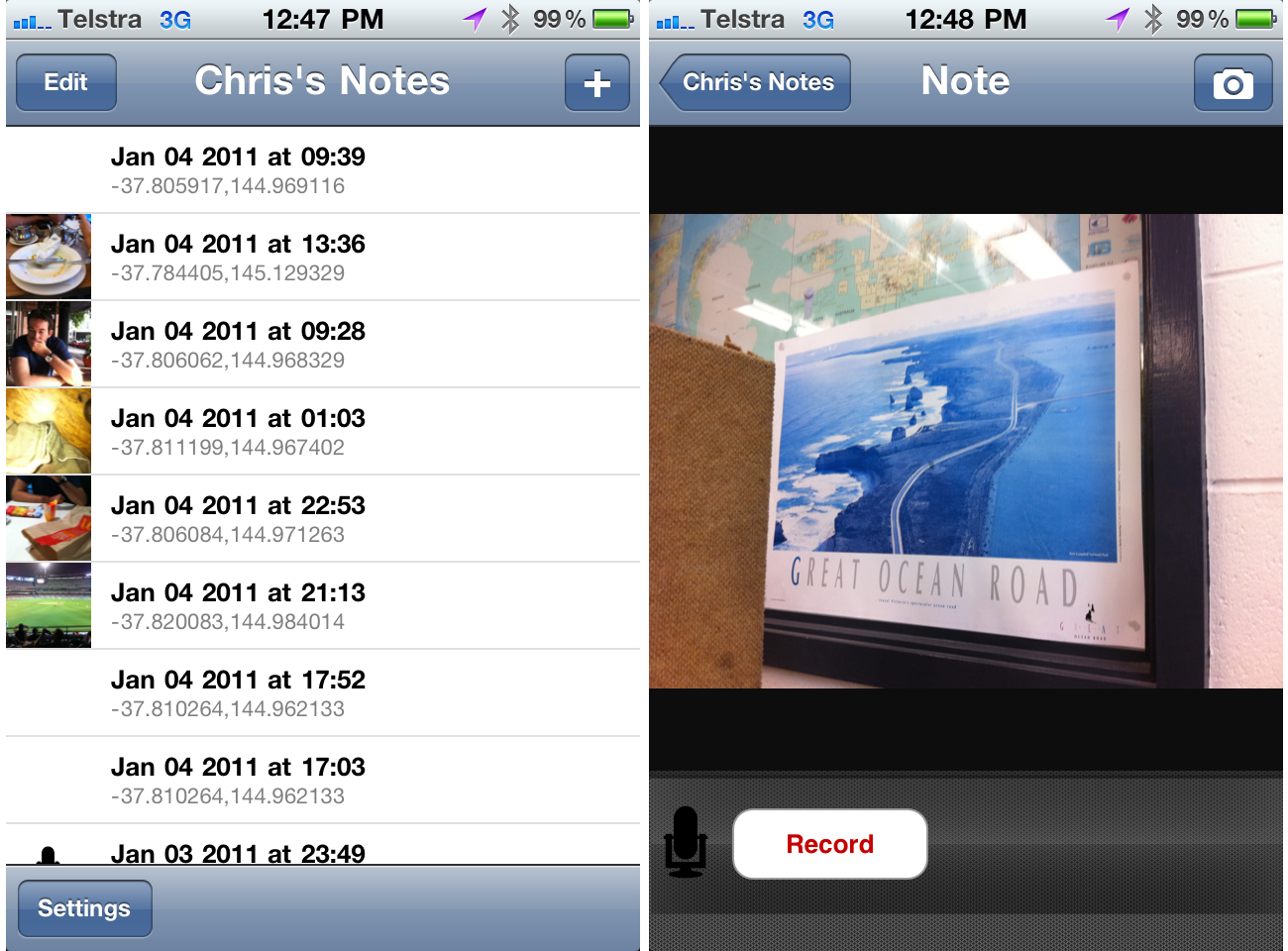
To this end, and given the extra-special role that location plays in my research, Reuben and I have built a custom application for park rangers, that asks them to provide thick descriptions of the locations they manage.

The application is mobile based (iOS specifically), and relies on a combination of GPS, photography and audio descriptions to gain a subjective sense of the spaces and places rangers make decisions about.

Each entry into this diary app is time-stamped and can be any combination of coordinate, photo and audio description. It’s this combination of audio and visual input that is the most powerful – given the nature of a park rangers job, audio descriptions are the most effective means of capturing the actions of rangers, and one that matches their current behaviour more closely than text based descriptions.

The goal is to create a low barrier to entry for rangers wanting to talk about their jobs as they’re doing them. Rangers will then be allowed to self-categorise/tag entries ex situ, before being visualised and used as discussion points in follow-up interviews.

The above screenshots are from the first functional version of the app, with many more improvements (particular design) to come.

Focusing the diary

To help guide the use of this application, we’re providing rangers with a set of guidelines on what types of information and input we’re interested in. Broadly, we’d like them to capture their interactions with other rangers, the decisions they make, the information they use in making these decisions. Given the role of location in all of these research questions, their entries will be analysed and visualised on maps to allow them to comment on the relationship between themselves and their environment.

We want to make this a fun activity for rangers, and we’ll be conducting kick-off sessions, and I will be following rangers into the field regularly to make my own observations and hopefully help overcome any confusion about the study before rangers are left alone with the application.

Wrap up

Thick description is a key part of the qualitative research I will be conducting with rangers at Wilson’s Promontory national park – I hope to uncover deep relationships between the rangers themselves and the locations they manage. As part of a much wider research program, we’ve designed and implemented a location-based diary study tool that will allow us to conduct remote research to be used as probes for further interviews.

Next for us is to build a visualisation interface for all this data – one that will allow us as researchers a way of making sense of qualitative data about locations, but one that will hopefully provide the basis of a knowledge management tool for Parks Victoria themselves.

References

Please note that the links below are to purchase the references I use in this post on Amazon. If you do find them interesting and decide to purchase them, I collect a small commission. Doing so will help support this blog (and my research!) in a small way, and I will be very grateful!

The missing network

One of the challenges of my project, from a technical perspective, is the non-urban environment it is situated in. Whilst it’s well and good to say that the solution will be context-aware and mobile, the reality is that the infrastructure that we take for granted in cities simply does not exist in a national park that is 3 hours from a major urban centre.

In one sense this is what (I hope) makes my research unique – we can’t gorge ourselves on infrastructure. 3G Networks are sparse, if not unrealiable, and WiFi is a pipe dream. GPS does exist and can be counted on, but when the core of the project is around the sharing and creation of knowledge, ideally in real-time, having an accurate reading of a ranger’s location is nice but not enough. There’s data involved, and quite possibly large quantities.

So – how do we facilitate this kind of knowledge ecosystem when the tubes are narrow, or don’t exist at all?

Well, the first thing a good researcher does is to peek over someone else’s shoulder. Although they may seem like polar opposites, the most similar environment I can think of that resembles a national park in terms of infrastructure is – wait for it – a plane.

This may change in the coming years (months?), but as it stands, planes have almost the same characteristics as a park. Sparse network access with absolutely no data connection, GPS works, but only if you’re even allowed to use your location-aware device at all.

Offline data storage is the obvious answer. WindowSeat App is an iOS application that stores offline data about points of interest you may be hurtling over at a given point in time. Its data set is fairly finite, so this model works well – however, in an app that is perceived as, and by necessity is, disconnected, how much of a barrier will there be to people wanting to contribute back to that data pool? Can we rely on people to sync, or should we be bold enough to make that decision for them?

The above picture is a phone tower disguised as a tree in Masai Mara National Park, Kenya

A Refresh

It’s been 12 months since I started my PhD, and it’s probably a good time to take stock and figure out exactly where I’m taking things. I wrote an original abstract after our initial visit and talks to park rangers, and have had it stuck to my wall since. Today, finally, it bugged me – so, I thought it was time to present to you a new one; followed by some of the major changes in the stances I’m taking.

Read the new abstract here.

So… what’s changed?

Context awareness

The major difference is the change from “location based” to “context aware”. Whilst location is still a large part of the research, location is just one variable in the broader notion of context – location isn’t enough when it comes to understanding the knowledge people have about somewhere; the meaning people attach to the raw “space” – a GPS coordinate- provides far greater meaning to the knowledge that is used and created there.

This notion of a raw location augmented with social meaning is referred to as “place”, and it is this socially constructed notion of location – not an x,y coordinate – that I will use as the core meaning of the term “context”.

Facilitation

Following from the idea of “social construction”, I’ve made it a point to explicitly state that whatever I design/build will not aim to interpret and provide meaning itself, but will consist of services and interfaces that allow people to construct their own interpretations of data, and to communicate it with others. The idea of knowledge as a social object is important here, as is literature around communities of practice and situated cognition. It’s more meaningful if you let people discover things for themselves.

Removing tacit

I’ve taken the word “tacit” out of the abstract – not because I won’t be dealing with it, but because I’ve wondered if it’s too limiting. The idea of facilitating knowledge discovery and creation is still directly related to tacit knowledge – the kind that cannot be easily gained or taught – and I feel that this implied direction is enough without explicitly stating I’m going to solve the world of it’s tacit knowledge problems.

The social life of knowledge

I’ve also deliberately used words to describe the cycle knowledge goes through in it’s social contexts – retention, generation, and communication. The system should facilitate all three activities equally, and with as seamless a transition between them as possible.

And next…

This refocuses the project somewhat – now, to actually make something.

Location is not enough

Progressing on from my previous post regarding the subjective nature of locations in a National Park (i.e. that rangers view places differently from each other and that their views may also change over time), I have written something in the conclusion of my OZCHI paper that I think hits the nail on the head. Location is not enough – location is just a coordinate. The question is, how can you infer the context that exists between a location and the person? Why is that person in a place and what are they hoping to do there?

Here’s the part from the paper. If you’d like the references mentioned just let me know:

Geovisualisation is an important tool that assists in the analysis and discovery of information amongst the plethora of location-based data we now have ready access to. The act of visualising data is repaid exponentially in terms of cognitive savings (Larkin & Simon, 1987), and can lead to the formation of deeper and better quality understanding about a problem domain (Lowe and Bouchiex, 2008).

However, the subjective, social nature of knowledge does highlight the importance of people in the ecology of sense-making and knowledge discovery – it is important not only to understand how people will interact with geo-visualisation interfaces, but also how they go about generating and absorbing knowledge from their existing social structures; that is, how they share and communicate with each other.

Any intelligent interface designed to meet the needs of the current research project should not only be concerned with the display of location-based data, but it should also be aware of the social and environmental contexts in which it is being used.

Subsequently, it is not enough that data being displayed be tagged with a location in the form of GPS coordinates. From a machine and computational perspective this is the necessary first step towards providing information about a place, but from a human-interaction perspective the display and dissemination of this data needs additional context. Simply: a person may be in the same location for entirely different purposes, and an intelligent location-based service needs to be aware of this purpose.

Geovisualisations are an important tool for the sense and decision-making processes, but it is the role of the holistic design of a system (that includes geovisualisation) to infer a better quality understanding of the goals and motivations of a user based on their location. It is hoped that further research in this project will provide insights into how location can be augmented with this further context, and how geovisualisation can assist users to explore this.

I think I’ve latched on to a new take on the project, but I need to do more reading into ubicomp and context-awareness to get a better understanding of what work has already been done in this space.

Any suggestions? Thoughts? Thanks!

This is significant because…

I’ve been working on my ethics submission for the last week or so, and one of the requirements is to explain in layman’s terms just what it is I’m meant to be doing, and why it’s significant. I probably haven’t quite nailed it yet, but here’s what I mustered up as a first draft. Hopefully it will provide a bit more insight into what it is I’m hoping to achieve.

Read more