This is an archival copy of my PhD blog, which was active between 2009–2015. I'm publishing it again as a personal time capsule, but also because I think it's an interesting documentation of the PhD process itself, which might be useful to someone, somewhere. – Chris Marmo, January 2026

Reframing Space for Ubiquitous Computing

My PhD thesis is now available as a free PDF download (28mb), a free eBook and a print-on-demand book.

With sufficient space between me and the end of the PhD process, I feel like it’s time to share the fruits of 3.5 years with readers of this blog. Whilst there’s still much within the document that I want to distill and communicate here and elsewhere, I think it’s important to provide (open) access to something that was tax-payer funded, and contains content I hope people across a wide range of industries and interests will find useful.

product_thumbnail

The thesis contains about 284 pages of reference-rich research on topics ranging from the temporality of landscapes, infrastructural rhythms, spaces of a natural disaster, and more. It provides a case-study of reflective design and ethnography across multiple sites, and contains lots of meaty detail on digital research methods, and how research can act as prototyping. It also contains detailed scenarios and designs for two conceptual systems aimed at tacit knowledge production in natural environments: Wayfarer, and HABITAT.

If you’re interested in any of the following, then there might be something in here for you:

  • Framing technology as a cultural and social process
  • Investigations into the multi-faceted ways we know and understand our environments
  • Digital ethnography and research methods
  • Reflection through action, research through making
  • Ubiquitous Computing at-large, and it’s related trajectories
  • National Parks, conservation, and the business of managing in these contexts
  • Challenges for government organisations as they enter the messy world of big-data and ubiquitous infrastructure

I’ve made the ebook free to whoever wants it, and have tried to keep the price of the print on demand book as low as possible. Unfortunately, the colour version was far too expensive (in my opinion) to bother with, but if you’re interested in this then please let me know.

Doing this project was one of the most rewarding experiences of my life, and I’m proud to be able to share it here. I’m hoping the ideas strike a chord with some of you.


Head down

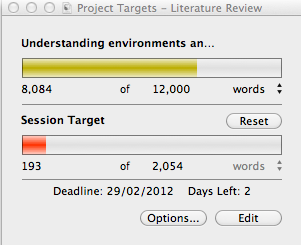
This is a quick post to break the drought here, and to let the world know that I have been working. The above picture is from Scrivener – my writing program of choice – showing the word target for my literature review. Writing this has been enjoyable so far (sort of), and has caused me to rethink and rework much of the approach I’m taking to the thesis overall. I’ve been doing lots of reading on human geography, and that topic will take up much of the remaining 4000 words.

The general gist of the literature review: Spatial concerns like distance, time and “place” (the social interpretation of a location) have been seen as things to overcome and solve through technology. But what if (like in human geography), we saw them not as something to solve, but as things to embrace? How does that change the way we approach new technologies?

Also, I find it pretty amusing that a 12,000 word document no longer scares me.

The park as a design space

My case study site is Wilson’s Promontory, a national park situated in the rural south east of Victoria, Australia. Whilst my thesis will broadly discuss the roll of environmental understanding (from a cultural geography perspective) in the design of technology for use in these types of settings, the “practical problem” I’m faced with is to make something for the park and it’s rangers. As an exercise it’s worth thinking about the space of the park as a context for design, exploring the implications this may have and distilling what aspects of this environment might be meaningful for design.

The park is a (semi) natural place

Most technology is designed for urban contexts, by designers with urban perspectives. As Bidwell & Browning (2010) explain, this monocultural approach to technology can lead to significant amounts of dissonance when it comes to use in rural settings. Screen glare is a common example of technology going fundamentally wrong in a natural setting – but other examples, such as the unsuitability of social networks for rural lifestyles, have also been explored. It’s important to challenge assumptions about traditional (i.e. urban) design approaches when moving away from cities and into natural and rural settings.

So, as a starting point it’s important to define what a “natural place” is. Bidwell & Browning give an definition based on two criteria: population density, and access to infrastructure. A natural environment, according to them, is sparse in human population and has limited built infrastructure. The park is an interesting landscape in this regard, because it has a combination of “urban” settings along with completely unpopulated, infrastructure sparse locations.

Population

  • The park has a small set of staff who live on-site in Tidal River (described as a “small town”).
  • Most staff commute to the park from surrounding rural centres, and a significant portion of the park management and planning happens in administration hubs in nearby Foster, and further away in the CBD of Melbourne.
  • Tourist populations fluctuate wildly, depending on the season, and (primarily) school holiday schedules.
  • The flow of people to the park is therefore predictable, but consists of extremes that make it difficult to categorise the park as a “natural place”, consisting of sparse populations.

Infrastructure

  • The camping grounds of Tidal River have been referred to as a “small town”, with all the comforts and amenities expected of a highly frequented tourist site. It even has an outdoor cinema to cater for large, restless school groups.
  • Highway quality roads provide easy access to Tidal River. Most of the frequented tourist destinations in the park are easily accessible by walking trails off the main road. Similarly, ecological research areas, and other general “areas of interest” for rangers are close to the main road between Yanakie (at the park’s entrance) and Tidal River.
  • Walking trails provide access to a large portion of the park not accessible by vehicle.
  • Mobile phone reception is generally mapped to the tourist population hubs, but it’s possible to get a signal is most areas of the park that are human accessible.

So, on the one hand we have a tightly “cultivated” area of the park – those most frequented by tourists, and heavy on built infrastructure. On the other, we have a largely preserved or “uncultivated” areas – where built infrastructure is extremely limited. It is at once a “natural place” – as defined by Bidwell & Browning – but also a tourist space, where populations fluctuate and infrastructure is at least as developed as in surrounding town centres. All the while, the digital infrastructure is not discriminating – cellular towers provide adequate coverage to most human-accessible areas.

Given this dichotomy of populations and infrastructure, it’s difficult to classify the park as either a “natural place” or an “urban environment”. It has elements of both, but it is truly neither. Is it right to call somewhere a “natural place” if you’ve got full reception on your iPhone? If it’s a particularly busy day, with many thousands of people in the park, do we suddenly call it “urban”, despite being surrounded by native flora and fauna?

Emerging geographies as a design space

Given the difficulty in classifying the park as either “natural” or “urban”, it’s worth examining the park as a set of different geographies that are not in competition with one another, but are complimentary perspectives that emerge through interactions between and by people (particularly, rangers) in the park. The previous two posts have begun to address varieties of these perspectives – how the movement and flows of rangers construct a particular perspective of the park space, and how the geography of infrastructure might act as an index to the knowable areas of the park.

Some further “geographies” that seem to be coming out of interviews and diary entries speak to the follow categories:

  • A geography of emotions – How emotive connections are formed to the landscape, and the particular form of knowing this invokes. This is salient in the time surrounding natural disasters (such as fires and floods).
  • A geography of administration – This was hinted at above, with mention of the differing geographical locations of the management of the park. There are those situated in the park itself, but also those in nearby rural centres, and the metropolitan central office. The flow of information, decisions, and people from and to these locations is worth exploring.
  • A geography of indigenous knowledge – Parks Victoria is working on co-management strategies that incorporate the traditional land-owners in the management of the park, and are working towards ways of including the knowledge of the landscape with current practice.
Each of these provides interesting design implications and constraints, challenges and opportunities. If we think of the Park as a collection of enacted meanings rather than a singular objective unit of analysis, we can begin to select and narrow down the design scope to target particular challenges within those spaces.
I highly recommend the article I’ve referenced here to anyone who is interested in the design of technology that is broader in scope than traditional, urban and “mono-cultural” settings.

References

  • Bidwell, J. & Browning, D. (2010). Pursuing genius loci. Personal and Ubiquitous Computing.
Personal Geographies

Personal geographies is a term I’ve been using in (thus far private) writing and preliminary analysis of diary studies and interviews I’ve conducted with park rangers. The above picture is the result of combining a particular kind of personal geography – jogging trails through New York city. It’s also an increasingly common type of visualisation; the visualisation of movement to emerge the shape of a space. Twitter heat maps and flickr overlays are also in vogue (not that that’s a bad thing!). The best thing about personal geographies is that, when combined, they form social geographies; the sense of place that has arisen through a community’s interaction with the city. What the visualisation above shows is a particular interpretation of a place, and one that was not necessarily deliberate.

This is also another example of digital data imposing itself on the physical world – it’s becoming increasingly easy to access the data in the digital layer above us. The seams between digital and physical are blurring too; as this example shows, our physical being in the world increasingly generates digital data, without consciously creating “content”. Conversely, the act of deliberate “generation” of content can influence our physical space and the actions we take in them. At the most basic level, think foursquare check-ins influencing which bar you go to.

We’re already living in a hybrid physical/digital world – and they’re increasingly influencing each other in ways designed or not. In fact, the duality of physical and digital may be a generational divide – in 100 years (less?), it will most likely sound comical to separate the two.

Link: Drawing New York

Code/Space

Code/Space is a body of research that looks at the creation of space through technology. Similarly, it looks at how technology is transforming the relationships people have with places, such that traditional separations of virtuality and reality may no longer be necessary.

It’s another thread of ubicomp research, except this time with a geographical focus. Nice.

Virtual Spaces

One of my favourite blogs at the moment is UrbanTick, run out of University College London. It’s a good mix of technology, architecture, environments and of course, people. It particular its a great source of geographical visualisations: representations that sit at the intersection of all these things.

Visual Cities is my latest discovery through that blog – visualising geocoded twitter and flickr data. Its creator states: “By revealing the social networks present within the urban environment, Invisible Cities describes a new kind of city—a city of the mind”.

This touches on what I think is the core of my phd: the representation of knowledge about locations – that the world that exists in our minds, and the one that is created socially, is not necessarily evident in the environment, but exists physically on servers across the world, and virtually in a meta-layer above our heads.

One interpretation of ubiquitous computing is that there is potential to incorporate this information back into the environment, removing the dissonance between space and our understanding of it. Visualisations are a step towards that: towards making the abstract tangible and actionable.

Reuben, who I’ve been working with for a few years on a number of things, also talked about this and built his own simple geo-visualisation for the iPad, framing it as an “historical narrative”.

Together we’ve been building a tool that will allow people to create their own meta-data about places, and collectively manipulate and interpret this data to create knowledge. The more I think about the different strands of my research, the more I see them converging. After about a year of fuzzy directions and more questions than answers, its relieving to see a somewhat clear path is emerging.

Augmenting the new with the old

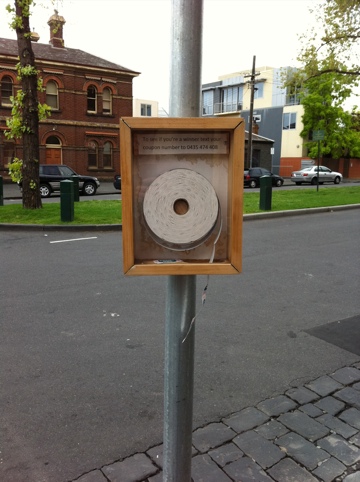
There seems to be a recent trend towards augmenting new services with nostalgic versions from less tech-y times – the above taken on an inner city suburban street in Melbourne; it invites people to take a token and SMS the code. Just because you can pull out the technology, doesn’t mean you should.