This is an archival copy of my PhD blog, which was active between 2009–2015. I'm publishing it again as a personal time capsule, but also because I think it's an interesting documentation of the PhD process itself, which might be useful to someone, somewhere. – Chris Marmo, January 2026

Dissecting cities

Armelle Caron has started a project dissecting the grids of cities, and laying them out linearly. The above is a picture of every single block in Paris. New York, Istanbul and Berlin have also been dissected. It’s a really interesting way of visualising the complexity of the city and it’s network of streets, walkways and alleys. It’s amazing how many of them look like faces to me.

Thanks to Owen for pointing this out!

The park as a design space

My case study site is Wilson’s Promontory, a national park situated in the rural south east of Victoria, Australia. Whilst my thesis will broadly discuss the roll of environmental understanding (from a cultural geography perspective) in the design of technology for use in these types of settings, the “practical problem” I’m faced with is to make something for the park and it’s rangers. As an exercise it’s worth thinking about the space of the park as a context for design, exploring the implications this may have and distilling what aspects of this environment might be meaningful for design.

The park is a (semi) natural place

Most technology is designed for urban contexts, by designers with urban perspectives. As Bidwell & Browning (2010) explain, this monocultural approach to technology can lead to significant amounts of dissonance when it comes to use in rural settings. Screen glare is a common example of technology going fundamentally wrong in a natural setting – but other examples, such as the unsuitability of social networks for rural lifestyles, have also been explored. It’s important to challenge assumptions about traditional (i.e. urban) design approaches when moving away from cities and into natural and rural settings.

So, as a starting point it’s important to define what a “natural place” is. Bidwell & Browning give an definition based on two criteria: population density, and access to infrastructure. A natural environment, according to them, is sparse in human population and has limited built infrastructure. The park is an interesting landscape in this regard, because it has a combination of “urban” settings along with completely unpopulated, infrastructure sparse locations.

Population

  • The park has a small set of staff who live on-site in Tidal River (described as a “small town”).
  • Most staff commute to the park from surrounding rural centres, and a significant portion of the park management and planning happens in administration hubs in nearby Foster, and further away in the CBD of Melbourne.
  • Tourist populations fluctuate wildly, depending on the season, and (primarily) school holiday schedules.
  • The flow of people to the park is therefore predictable, but consists of extremes that make it difficult to categorise the park as a “natural place”, consisting of sparse populations.

Infrastructure

  • The camping grounds of Tidal River have been referred to as a “small town”, with all the comforts and amenities expected of a highly frequented tourist site. It even has an outdoor cinema to cater for large, restless school groups.
  • Highway quality roads provide easy access to Tidal River. Most of the frequented tourist destinations in the park are easily accessible by walking trails off the main road. Similarly, ecological research areas, and other general “areas of interest” for rangers are close to the main road between Yanakie (at the park’s entrance) and Tidal River.
  • Walking trails provide access to a large portion of the park not accessible by vehicle.
  • Mobile phone reception is generally mapped to the tourist population hubs, but it’s possible to get a signal is most areas of the park that are human accessible.

So, on the one hand we have a tightly “cultivated” area of the park – those most frequented by tourists, and heavy on built infrastructure. On the other, we have a largely preserved or “uncultivated” areas – where built infrastructure is extremely limited. It is at once a “natural place” – as defined by Bidwell & Browning – but also a tourist space, where populations fluctuate and infrastructure is at least as developed as in surrounding town centres. All the while, the digital infrastructure is not discriminating – cellular towers provide adequate coverage to most human-accessible areas.

Given this dichotomy of populations and infrastructure, it’s difficult to classify the park as either a “natural place” or an “urban environment”. It has elements of both, but it is truly neither. Is it right to call somewhere a “natural place” if you’ve got full reception on your iPhone? If it’s a particularly busy day, with many thousands of people in the park, do we suddenly call it “urban”, despite being surrounded by native flora and fauna?

Emerging geographies as a design space

Given the difficulty in classifying the park as either “natural” or “urban”, it’s worth examining the park as a set of different geographies that are not in competition with one another, but are complimentary perspectives that emerge through interactions between and by people (particularly, rangers) in the park. The previous two posts have begun to address varieties of these perspectives – how the movement and flows of rangers construct a particular perspective of the park space, and how the geography of infrastructure might act as an index to the knowable areas of the park.

Some further “geographies” that seem to be coming out of interviews and diary entries speak to the follow categories:

  • A geography of emotions – How emotive connections are formed to the landscape, and the particular form of knowing this invokes. This is salient in the time surrounding natural disasters (such as fires and floods).
  • A geography of administration – This was hinted at above, with mention of the differing geographical locations of the management of the park. There are those situated in the park itself, but also those in nearby rural centres, and the metropolitan central office. The flow of information, decisions, and people from and to these locations is worth exploring.
  • A geography of indigenous knowledge – Parks Victoria is working on co-management strategies that incorporate the traditional land-owners in the management of the park, and are working towards ways of including the knowledge of the landscape with current practice.
Each of these provides interesting design implications and constraints, challenges and opportunities. If we think of the Park as a collection of enacted meanings rather than a singular objective unit of analysis, we can begin to select and narrow down the design scope to target particular challenges within those spaces.
I highly recommend the article I’ve referenced here to anyone who is interested in the design of technology that is broader in scope than traditional, urban and “mono-cultural” settings.

References

  • Bidwell, J. & Browning, D. (2010). Pursuing genius loci. Personal and Ubiquitous Computing.

Geographies of access

Following on from the last post on an analysis of the movement of rangers, I’d like to discuss another interesting (if not obvious) finding from the diary study. That is: that accessibility dictates what is possible to know.

Access and infrastructure are common topics in ubiquitous computing literature – access to “digital space” is dependant on infrastructure that supports it: a wifi signal, 3G telecommunications towers, an internet cafe. Similarly, infrastructure can dictate the ways we navigate a space – we might choose a cafe to eat at depending on the likelihood of an internet connection; less “digitally” focused, the car route we choose to one destination depends on the roads that exist, but then also our knowledge of the likely traffic conditions of those roads. In each case: access to infrastructure (and the quality of that access) influences our behaviour.

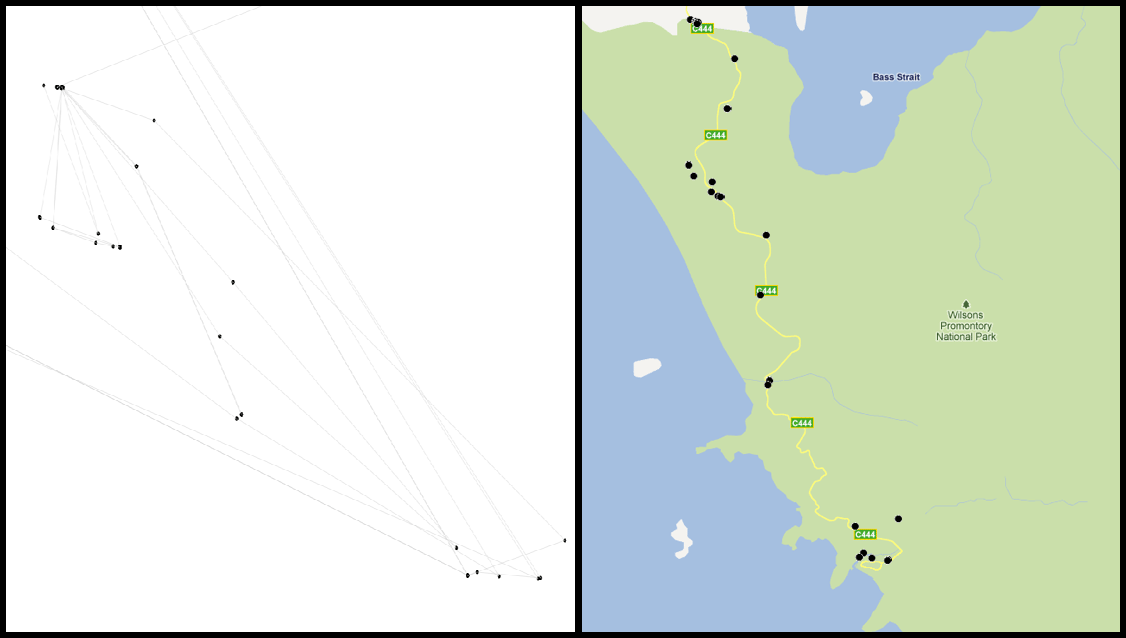
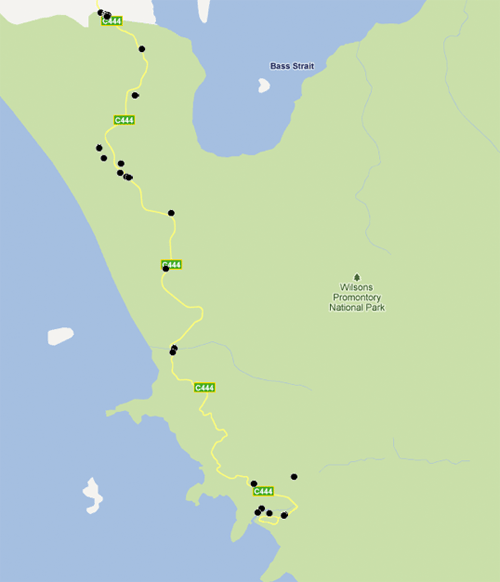
This isn’t as obvious in the image I generated for the previous post, but after doing a lazy google map of the data the trend is clear: almost all entries were made on or near a road. Even those taken “off road” were generally not far from it – judging from conversations with rangers, these places are generally within walking (or equipment-carrying) distance of their vehicles. Also, the few outliers visible on the map are taken along walking tracks, rather than roads. The volume of recordings on a place depends on the bandwidth of the access. Roads are high bandwidth, walking tracks less so – dense scrub: very low.

Some questions that this raises:

  1. How can you design for discovery of “new” knowledge when data-rich areas are also, by necessity, the most familiar?
  2. What opportunities will there be for technology to encourage exploration of new areas?
  3. How will existing infrastructure and accessibility to the park limit the potential for exploration?

Geographies of Movement

Over the last few months I’ve conducted a mobile diary study with rangers at the study site, Wilson’s Promontory National Park. Six participants were asked to record a number of entries as they went about their daily activities: a) Things they wanted to show other people, b) interesting observations for themselves, and c) recollections of a past experience, amongst others. Analysing the qualitative contents of these entries has revealed much about the connections between Parks Victoria staff, the park itself, and their tools and technology. At the same time, I’ve been doing some programmatic/quantitative analysis of the entries – mainly, the combination of timestamps and the attached location data.

I’d like to give a quick overview of some of the early findings of the study. Before that though, it’s worth talking a little about movement, and how this has come to be understood as a key source of environmental understanding.

Movement is knowing

Movement and mobility are becoming key concerns in the areas of sociology, human geography and ubiquitous computing. The sociologist John Urry (2006) suggests that mobility – the flow of information, people, and goods – rather than fixed societies will be a key concern for sociologists this century. Similarly, in human geography the notion of unblocked space (Thrift, 2003) is one concerned not with fixed points, but with movement and flows through these spaces. Thrift argues that space should be viewed not as a boundary around these flows, but as the flows themselves. In this sense, movement through a space is the definition of it.

The synthesis of these and other theories are starting to inform elements of ubiquitous computing research. Distinctions between “space” and “place” have been used by CSCW researchers as a means of separating a “socially constructed” place, and the objective space for some time. By focusing on flow and mobility, researchers now to also view space as a social construct. As such, it’s possible to argue that our environmental understanding is tied up in our constructed notions of space. Bidwell et al. (2011) demonstrate this by looking at rural knowledge traditions in Africa which are often explained as spatial relationships. Brewer & Dourish (2008) similarly present cultural accounts of space, and highlight that much of our technology relies on assumptions about how we interact with our environment.

Both of these papers discuss spatial relationships in the context of knowledge, and highlight ways in which technology may be better designed to more closely match different conceptions of space.

The acts of Rangers

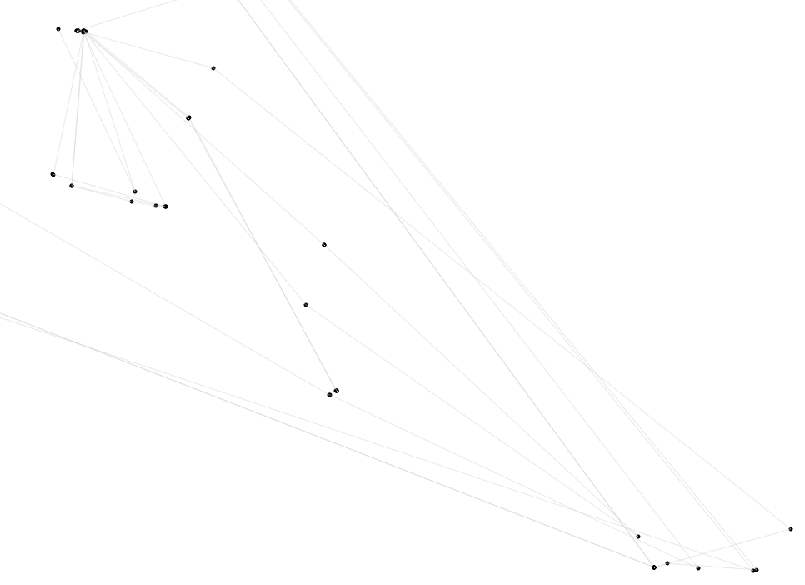
Ranger’s work is to manage the park; they do this through interacting with it, and it is through these interactions that they produce knowledge. The diagram above shows where diary entries were made (with a dot), but also the path they took between entries. Most entries were reports of things that happened between the last entry and the current one. This means that much of what rangers thought to be important happened on the lines – that is, in their movement between places. Keeping with the notions of flow and mobility mentioned above, the lines can be viewed as the space of the park, as enacted by the rangers. These abstract dots and lines, for them, are one way of representing the park as they act in it.

This picture also obviously emerges a sense of “hubs” – areas where rangers go back to, and move between commonly. I’m guessing most people familiar with the park will be able to pick out where these areas actually are based on this diagram. It’s these places where knowledge “from the field” is primarily shared, interpreted and enacted upon.

The lines going off the screen also indicate that the management of the park occurs not just in the park – the “geography of management” includes administration hubs in the city and surround areas of Gippsland. Whilst this image is centred on the (invisible) geographic area of the actual park, a significant portion of entries occur “off site”. The park is just one place in the network of movements and actions carried out by rangers.

There’s a lot more to say around this study. As I start writing the thesis chapter I have planned, I’ll keep posting refinements. In the meantime, enjoy the reading below!

References
Bidwell, N. J., Winschiers-Theophilus, H., Koch Kapuire, G., & Rehm, M. (2011). Pushing personhood into place: Situating media in rural knowledge in Africa. International Journal of Human-Computer Studies, 69(10), 618–631.
BREWER, J., & Dourish, P. (2008). Storied spaces: Cultural accounts of mobility, technology, and environmental knowing. International Journal of Human-Computer Studies, 66(12).
Thrift, N. (2003). Key concepts in geography.
Urry, J. (2006). The new mobilities paradigm. Environment and Planning A.

Code/Space

Code/Space is a body of research that looks at the creation of space through technology. Similarly, it looks at how technology is transforming the relationships people have with places, such that traditional separations of virtuality and reality may no longer be necessary.

It’s another thread of ubicomp research, except this time with a geographical focus. Nice.

Virtual Spaces

One of my favourite blogs at the moment is UrbanTick, run out of University College London. It’s a good mix of technology, architecture, environments and of course, people. It particular its a great source of geographical visualisations: representations that sit at the intersection of all these things.

Visual Cities is my latest discovery through that blog – visualising geocoded twitter and flickr data. Its creator states: “By revealing the social networks present within the urban environment, Invisible Cities describes a new kind of city—a city of the mind”.

This touches on what I think is the core of my phd: the representation of knowledge about locations – that the world that exists in our minds, and the one that is created socially, is not necessarily evident in the environment, but exists physically on servers across the world, and virtually in a meta-layer above our heads.

One interpretation of ubiquitous computing is that there is potential to incorporate this information back into the environment, removing the dissonance between space and our understanding of it. Visualisations are a step towards that: towards making the abstract tangible and actionable.

Reuben, who I’ve been working with for a few years on a number of things, also talked about this and built his own simple geo-visualisation for the iPad, framing it as an “historical narrative”.

Together we’ve been building a tool that will allow people to create their own meta-data about places, and collectively manipulate and interpret this data to create knowledge. The more I think about the different strands of my research, the more I see them converging. After about a year of fuzzy directions and more questions than answers, its relieving to see a somewhat clear path is emerging.

Context: awareness vs sensitivity

I’ve been doing a lot of reading and writing around context awareness the past couple of months – so much so that I changed the subtitle of this site to include it. It’s safe to say that the notion of this kind of awareness completely captured my imagination, or at the very least, led me to line up a whole stack of journal articles and books on the topic.

With the plethora of location-based applications appearing on various mobile platforms, the ubiquitous nature of geo-tagged data and the popular medias seemingly undying thirst for the latest tech-innovation, location enjoyed a pretty good ride in 2010. Starting at location as a focus of research (as I did), it’s not long before you realise that a coordinate is just one piece of metadata that can describe context, and it seems like a natural progression to begin thinking about broader notions of the term.

The next thing you realise after reading all about the current attempts at context-awareness is that, well, they suck fail to be all that useful.

There are many very intelligent systems-based frameworks for building an architecture of sensors that can detect where and what you’re doing, and very detailed examples of software implementations that aim to interpret this sensor-based data to assist their users. It’s not that these frameworks and implementations are poor or under-thought, it’s simply that the technology isn’t there yet, and our expectations are too high.

Great Expectations

This isn’t our fault though – the term “aware” is loaded with expectation. It immediately conjures notions of Asimov-type robots that basically act and understand as we do – of computational uber-humans superior to us in every way – and ones that we will either grow to love or fear completely.

The problem is hinted at above – in the interpretation. Whilst we might have sensors that can pinpoint you on a map, know who you’re with, whether you’re talking or not, walking or not, whether you’re standing, sitting, or lying down, the problem lies in the translation of this sensorial information into meaningful, and accurate interpretations for software to use.

The optimist and sci-fi fan in me thinks that, one day, we will see a convergence of sensor technology and artificial intelligence that will provide useful scenarios to people. You might argue this happens already – a pilot’s cockpit springs to mind. But the fact remains that the detection of meaningful, dynamic and social context is a long way off.

Context is socially constructed

I’m working on a longer article on this at the moment, so I won’t go into too much detail. It is worth noting however, that whilst the cockpit of a plane is a highly controlled environment where all variables are know, much of what we would define as context is socially constructed. That is, its existence is fleeting, and only arises out of interaction between people, objects and the environment.

Whilst we may be able to detect your location fairly accurately, the context to your presence there is very difficult to detect. Test this next time you’re in a cafe – note all the different activities that are taking place there. The animated conversations, the quiet reading, the anxious waiting, the scurrying (or bored?) staff. For each of these actors, the place holds a completely different meaning for them – and hence, a different context.

Context Sensitivity

So if we can’t rely on technology to sense and interpret that kind of context, then what can we do? Well, I’m not sure I have any answers to this, but I would suggest that we first lower the expectations of and burden on our technology. When compared to “awareness”, a word like “sensitivity” seems much more realistic. We can’t do Bicentennial Man just yet, but what we can do is make intelligent assumptions about when, where and how our technology might be used, and we can selectively use sensed data to inform the design of our applications.

That is, I believe it is the role of design to augment the technology – instead of relying on technology to give us context awareness, we should rely on design to give us context sensitivity.

Thick Description

This week I finally received my ethics approval. For those who haven’t had to deal with an university ethics committee before, it’s a notoriously lengthy and tedious process. I managed to have my research methods approved within 3 months, which is about half the time it took my research partner – so understandably, I’m pretty happy!

As part of the ethics submission I essentially planned out every stage of the hands-on research I’ll be conducting with park rangers. I’m relying heavily on qualitative methods to uncover the behaviour, goals and habits of park rangers as they go about their jobs – focusing on who they communicate with, what information they impart and use, what decisions they make, and how all of this related to their notion of location. Essentially, I’m treating park rangers as a community with their own set of practices, and, through qualitative research, am hoping to uncover deeper links between themselves and the spaces they manage.

Thick description

A key aspect of almost all qualitative research is the notion of “thick description” – a term that appears in just about every text book on the subject. However despite it’s seeming importance, it’s a notoriously difficult concept to define. There have been numerous attempts, as documented in Joseph Ponterotto’s paper from 2006 (reference below).

In 1973, Geertz was the first to use the term in relation to qualitative research, and states the following:

From one point of view, that of the textbook, doing ethnography is establishing rapport, selecting informants, transcribing texts, taking genealogies, mapping fields, keeping a diary, and so on. But it is not these things, techniques and received procedures that define the enterprise. What defines it is the kind of intellectual effort it is: an elaborate venture in, to borrow a notion from Gilbert Ryle, “thick description”.

Denzin (1989) attempts to define thick description by comparing it to “thin description”. According to Denzin, thick description has the following features:

“(1) It gives the context of an act; (2) it states the intentions and meanings that organize the action; (3) it traces the evolution and development of the act; (4) it presents the action as a text that can then be interpreted. A thin description simply reports facts, independent of intentions or the circumstances that surround an action. (p. 33)”

Other definitions essentially equate it to doing ethnography – in that, the actual nature of ethnography is to gather thick descriptions. This is the most common link between the definitions – essentially, like ethnography as a practice, “thick description” can be said to provide context and meaning to observed actions, rather than simply recording the occurrence of an event in isolation. It’s more about recording the story of a fact, rather than the fact itself.

There are a number of ways to achieve the type of data that might be defined as “thick” – participant interviews, field observations, analysis of personal spaces and artifacts, and more. Diary studies are another well documented form, as part of a broader notion of a “cultural probe”. This is one which I intend to use with park rangers.

There’s an app for that
Thick Description

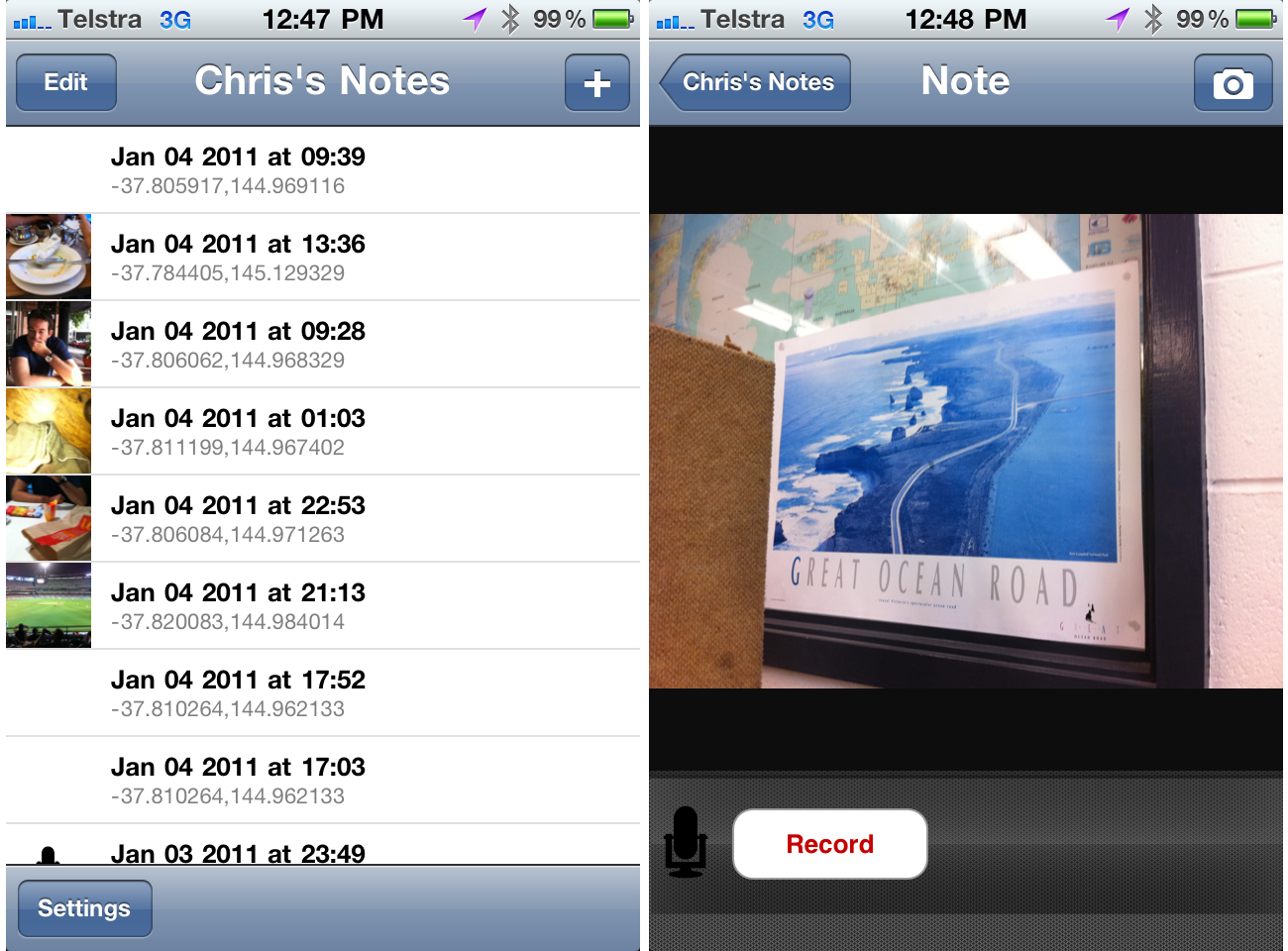
To this end, and given the extra-special role that location plays in my research, Reuben and I have built a custom application for park rangers, that asks them to provide thick descriptions of the locations they manage.

The application is mobile based (iOS specifically), and relies on a combination of GPS, photography and audio descriptions to gain a subjective sense of the spaces and places rangers make decisions about.

Each entry into this diary app is time-stamped and can be any combination of coordinate, photo and audio description. It’s this combination of audio and visual input that is the most powerful – given the nature of a park rangers job, audio descriptions are the most effective means of capturing the actions of rangers, and one that matches their current behaviour more closely than text based descriptions.

The goal is to create a low barrier to entry for rangers wanting to talk about their jobs as they’re doing them. Rangers will then be allowed to self-categorise/tag entries ex situ, before being visualised and used as discussion points in follow-up interviews.

The above screenshots are from the first functional version of the app, with many more improvements (particular design) to come.

Focusing the diary

To help guide the use of this application, we’re providing rangers with a set of guidelines on what types of information and input we’re interested in. Broadly, we’d like them to capture their interactions with other rangers, the decisions they make, the information they use in making these decisions. Given the role of location in all of these research questions, their entries will be analysed and visualised on maps to allow them to comment on the relationship between themselves and their environment.

We want to make this a fun activity for rangers, and we’ll be conducting kick-off sessions, and I will be following rangers into the field regularly to make my own observations and hopefully help overcome any confusion about the study before rangers are left alone with the application.

Wrap up

Thick description is a key part of the qualitative research I will be conducting with rangers at Wilson’s Promontory national park – I hope to uncover deep relationships between the rangers themselves and the locations they manage. As part of a much wider research program, we’ve designed and implemented a location-based diary study tool that will allow us to conduct remote research to be used as probes for further interviews.

Next for us is to build a visualisation interface for all this data – one that will allow us as researchers a way of making sense of qualitative data about locations, but one that will hopefully provide the basis of a knowledge management tool for Parks Victoria themselves.

References

Please note that the links below are to purchase the references I use in this post on Amazon. If you do find them interesting and decide to purchase them, I collect a small commission. Doing so will help support this blog (and my research!) in a small way, and I will be very grateful!