This is an archival copy of my PhD blog, which was active between 2009–2015. I'm publishing it again as a personal time capsule, but also because I think it's an interesting documentation of the PhD process itself, which might be useful to someone, somewhere. – Chris Marmo, January 2026

2011

To curb off a bit of the ol’ thesis anxiety, I thought I’d make a list of things-I-did this year. In no particular order, here are the things I liked (and possibly didn’t) this year.

Writing/Talking

My university (and supervisor) are great at encouraging and pushing their graduate students to write and publish their work. This year was no different, with a couple more publications to add to the list:

  • A paper for The International Cartographic Consortium conference around context-awareness in visualising geographical information. Presented in Paris, in July.
  • Doctoral Consortium paper for Mobile HCI. Presented in Stockholm, in September.
  • A book chapter in an upcoming RMIT publication around future social contexts of Geovisualisation.
  • Full paper for the LBS 2011 conference. Presented in Vienna, in November.
  • A visit to ARSyd to talk about how we make sense of location based data.
I also submitted a paper to CHI, which I thought was a bit ambitious of me. I was right – The paper wasn’t accepted, but neither were 77% of the others.


Mobile HCI
For me, probably the most exciting and fulfilling thing that happened this year was the trip to Stockholm, to participate in the doctoral consortium at Mobile HCI. I received amazing feedback, and left feeling encouraged (and validated!) in my take on my topic area. I also met many, many amazing people, including those at the MobileLife research centre, fellow PhD sufferers whose work I admire, and people I know I’ll be friends with for a long, long time. This is one of those things that you can’t help but gush about – but I’ll save you from more of that.

Apple’s WWDC

In June I attended Apple’s developer conference in San Francisco. I learnt quite a bit, but the most inspiring thing was seeing so many independent designers and developers working on things they love, and not starving during the process. I traveled with Reuben, who I highly recommend to anyone needing to share a hotel room. He doesn’t snore.

Paris

I had the opportunity to stay in Paris for the entire month of July – a week for the ICA conference, with three weeks tacked on to the end. Again, I met some great people and has some very interesting discussions about my work. I also rented a small apartment in Belleville, and worked on my french accent a little more. Weh.

Misc (or: stuff that doesn’t sound as cool).

After another year of “being a PhD student”, I feel like I’ve learnt some valuable lessons about how to be one of these wretched creatures. Particularly, I’d like to point out a few things about having a research question and involving others in your work:

  1. Let the data speak for itself. Do not try to shoe-horn your research into your own pre-designed agenda. When you first start something like a PhD, you can often get excited (and overwhelmed) by the number of possible directions you might take. Of course, you then choose one of them – generally something you really like, or care about. In a beautiful twist of fate, you eventually learn that you can’t choose what you observe. Research is cyclical, and you need to pay attention to what your data is telling you at all times. Your research won’t always be what you thought it would be.
  2. You need time. About half way through the year I stopped working completely, and became an actual full-time student. Granted, it was the “working” part that eventually allowed me the freedom to do this, but clearing my plate of all other commitments was one of the best decisions of the year. You need to be fully immersed in a research thesis, and even small, one day a week commitments can be distracting. You might lose a little bit of industry experience, but you’ve got the rest of your life to get that.
  3. Talk to people. Some of the best ideas and advice I’ve received have been in casual conversations with people in similar situations to me. At a pub. In a cafe. In a national park. Having a whinge every now and again is very important, but you should always take up any opportunity to speak about what you’re doing. Even if it leaves people utterly confused, hearing yourself explain something in a slightly different way will often spark new and exciting leads to follow up on. It also gets you out of your stuffy office, and highlights the value and importance of communicating your work effectively.

2012

Next year is my final year (hopefully), but I’m excited to see where it takes me. There probably will be a few less international sojourns, but I’m looking forward to producing a semi-decent thesis and beginning to explore where that might take me.



New plans: Essay-a-fortnight

Having recently cleared my plate of most other work commitments, I can now say for the first time, accurately, that I’m a full time student. I was only ever working one or two days a week, but those extra days are already making a difference.

When thinking about how I’d like to use this time, I found myself remembering Reuben’s app a week project. As a learning exercise for mobile development, he set himself the goal of making one app a week for 6 weeks. It seemed to work really well for him, so I’m going to borrow it!

App Essay a week fortnight

I’m not making apps (yet), so I’m structuring this around discreet strands of research in my PhD. One of my goals for this year was to write more, and I feel like an essay is an independent bite-sized piece of work that I won’t feel pressured in to including in my final thesis. Which, by the way, I have no idea how to structure at the moment. So I’m hoping this exercise will provide me with a nice collection of written material to draw from once I start putting the actual thesis together.

Reasons? I’ll give you reasons!

This is why I think this will work for me:

  • I work well to deadlines. My supervisors have been great a pushing me to write papers for conferences, etc, and I’ve found that setting a topic and writing on it is a good way to feel productive. Without a set topic and a deadline looming I’ve tended to either procrastinate or go off on too many unrelated tangents.
  • I have too many tangents. At the moment I have about 5 different areas of research that I’ve been reading about. Most of them overlap somehow, and to start structuring my thoughts on these in to chapters seems too hard at this stage. Again, I feel that focusing on these smaller, discreet pieces will allow me to move forward a lot faster. There’s something about having “Thesis.doc” open that scares me.

Rules? I have those too!

So i’m going to set myself my boundaries to stick to:

  1. Essays will be started on a Monday, and must be completed by the following Friday
  2. They should be a minimum of 2000 words and contain completely original writing. I can’t copy and paste things from other writing I’ve already done.
  3. They should essentially be a review of the literature with a particular take that is relevant to my research.
  4. I will post the essay topic on the monday with some recommended reading for anyone that is interested.
  5. I may or may not publish the final essay on this blog, depending on how I feel about it. I should post at least an introductory and concluding paragraph from the writing.
  6. So that’s it. I’m already a day behind this fortnight’s essay, so time to start planning it!

Not all rangers have beards

This week I went to a seminar that focused on communicating research. It was a pre-requisite for entering the 3-minute thesis competition, which seems like a mini-TED for research students with a time limit. I don’t know if I’ll enter the competition (although there’s some impressive cash amounts up for grabs), but I’ll definitely be using some lessons from the seminar in my writing. The main thing I took away from it was the importance of having a story around the research, and allowing people to feel an emotional connection to it. This post is my attempt to add that story.

The story of National Parks

People love national parks – they are places families go, where summers are spent, and where kids grow up. They provide an escape from architected office buildings, armpits on crowded trains and suburban peak hour traffic. The air is fresh, and the landscape is rejuvenating.

When such a place is ravaged by fire, those that have developed a connection to it feel violated – it’s as if their house has been burgled. An uninvited stranger crashes through, sweeping away the things they feel that connection with and leaving a shell. Like being burgled, it’s not just the memory of absent things that lingers – it’s the thought that the once unquestionably secure destination is no longer so. We never feel completely at home again.

On top of this, fire is devastating for the ecology of a park. When controlled, it is a necessary part of managing the landscape. When unplanned, it can permanently damage the land and the lives of the creatures that inhabit it.

It’s important that we do all we can to manage the risks of unplanned fire.

Some rangers live in the city, and not all of them have beards.

Luckily, there are people whose job it is to do this. Parks rangers are often based in the same park for many years, and over this time they learn to recognise signs in the environment that warn them that a fire may get beyond control. They have sensors that tell them about fuel levels and soil moisture, but, like most of us, they also rely on their instinct, or their tacit knowledge.

At the same time, back in the city, there are people who don’t wear khaki shorts who play just as important a role in the park. These people keep track of ecological research about parks, plan studies to discover populations of rodents, and keep tabs on the regrowth of native scrub. They also coordinate external groups of volunteers and researchers who contribute information back to the organisation, and provide those “on the ground” with the data they need to make decisions.

Both types of park ranger contribute to keeping the ecological balance necessary for healthy parks, and healthy people. However, both are struggling under the sheer weight of data available to them. Relevant scientific studies get lost in filing cabinets, and even when they are accessible they are not easily integrated into management plans. Similarly, rich, tacit knowledge is not accessible to other staff, and is lost completely when rangers retire or move on.

So on one hand, they need help dealing with the sheer quantity of data available to them. On the other, there’s a need to capture the rich, experiential knowledge that can help bridge the gap between the numbers, the park and the people in it.

A consensus of interpretation

The one common element to all of this data, information and knowledge is location. Reports are about regions in a park, rangers visit specific points and extrapolate their assessment to broader areas, and remote sensors are scattered in the park, forming a virtual topography of data on top of the natural environment.

Given the located and situated aspect of park management, it makes sense to give rangers tools to view information through the lens of location. It makes even more sense to give them tools through which they can record, interpret and use information about these places in the places themselves.

There are bodies of research that indicate that information makes more sense to us, and is more useful, when presented in the same context in which it is to be used. Facilitating the exploration of information in the places they are about can lead to the generation of better quality understandings of this information.

Similarly, we want to allow rangers to add their own meaning on top of this raw information, and to share and evolve that with other rangers. There’s also research, and indeed entire disciplines, that focus on computer supported collaborative work and show that the shared interpretation of data leads to better outcomes.

In the cloud

What this research plans to do is allow rangers to explore and interpret data about places, through mobile technology, in those very same places. Similarly, we want to allow rangers to share their interpretations of data with other rangers. By interacting with information and each other through mobile technology, rangers will ultimately form a human filtered and rich-in-quality body of knowledge that lives “in the clouds” above parks.

By giving rangers better access to the most important knowledge about parks, and particularly knowledge around fire management, they will be better equipped to manage and prevent unplanned fires. Uninterrupted, families can continue to form memories tinged with green, native flora and fauna can continue to flourish, and rangers can continue living in the country or in the city and with full freedom of choice around facial hair.

/eom

Well, that’s my first shot at adding some kind of narrative around what I’m doing. I’m in the process of applying to a doctoral consortium, and think this will really help me add context and reason to the more academic details. Thanks Inger!

A Refresh

It’s been 12 months since I started my PhD, and it’s probably a good time to take stock and figure out exactly where I’m taking things. I wrote an original abstract after our initial visit and talks to park rangers, and have had it stuck to my wall since. Today, finally, it bugged me – so, I thought it was time to present to you a new one; followed by some of the major changes in the stances I’m taking.

Read the new abstract here.

So… what’s changed?

Context awareness

The major difference is the change from “location based” to “context aware”. Whilst location is still a large part of the research, location is just one variable in the broader notion of context – location isn’t enough when it comes to understanding the knowledge people have about somewhere; the meaning people attach to the raw “space” – a GPS coordinate- provides far greater meaning to the knowledge that is used and created there.

This notion of a raw location augmented with social meaning is referred to as “place”, and it is this socially constructed notion of location – not an x,y coordinate – that I will use as the core meaning of the term “context”.

Facilitation

Following from the idea of “social construction”, I’ve made it a point to explicitly state that whatever I design/build will not aim to interpret and provide meaning itself, but will consist of services and interfaces that allow people to construct their own interpretations of data, and to communicate it with others. The idea of knowledge as a social object is important here, as is literature around communities of practice and situated cognition. It’s more meaningful if you let people discover things for themselves.

Removing tacit

I’ve taken the word “tacit” out of the abstract – not because I won’t be dealing with it, but because I’ve wondered if it’s too limiting. The idea of facilitating knowledge discovery and creation is still directly related to tacit knowledge – the kind that cannot be easily gained or taught – and I feel that this implied direction is enough without explicitly stating I’m going to solve the world of it’s tacit knowledge problems.

The social life of knowledge

I’ve also deliberately used words to describe the cycle knowledge goes through in it’s social contexts – retention, generation, and communication. The system should facilitate all three activities equally, and with as seamless a transition between them as possible.

And next…

This refocuses the project somewhat – now, to actually make something.

Reference Piles


Completing a PhD is meant to show that you are able to stick at a complex topic and explore it in a disciplined and systematic way, paying attention to existing literature and eventually, after some years, adding your bit to the vast pool of human knowledge.

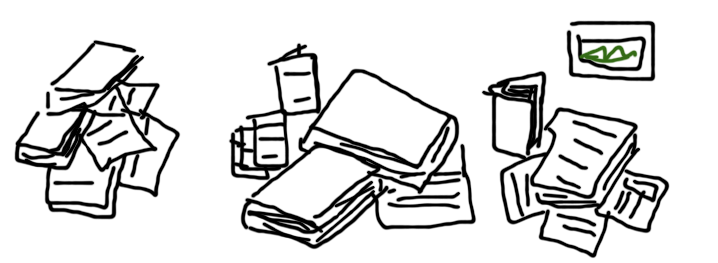
Research questions are the core around which you conduct these activities, and serve to focus your efforts when it comes to researching and exploring the vast amounts of information out there. Recently though, I find myself growing an increasing list of references in things that I’d really love to get a handle on, but seem to not have the time to digest fully. As a bit of fear of not remaining focus has crept in recently, I thought I’d consolidate some of my current and extra research interests. Inspired in a round about way by challenge piles, here are my Reference Piles representing the broad topics I’m interested in, and what questions I want to find answers to inside those.

Pile #1: Knowledge

I spent a long time trying to answer the question: “What is knowledge?”. It’s a lot harder than it sounds! I guess in 2.5 years time I will have taken a stance on it, but for now I’m going to remain deliberately vague and instead talk about what I think I need to know more about:

  • What I can learn from the more business-management style frameworks around knowledge, particularly tacit knowledge, or “know how”.
  • The more sociological side of things, revolving around communities of practice and the theories that discuss how we learn from each other, rather than what it is we actually learn. This should inform the design of a broader sense-making framework.

Pile #2: Visualisation

This is what I’ve written the most on in papers, etc to date and what I’m most comfortable talking about. I feel I’ve got a good handle on how we make sense of images, why they help us, and what makes a good one. Still, I’d like to find out more about:

  • Social objects, and how the actual artefact of a visualisation can be used to reach shared understandings. That is, how a visualisation can help groups of people understand versus just an individual.
  • Types and variations of geovisualisations and how I might be able to apply them

Pile #3: Location Based Services (LBS)

I’m positioning this research as exploring LBS in relation to a national park, but the reality is it is more context aware than location based as such. I’ve sort of started fresh with this in the last few weeks, so here is what I’m hoping to uncover:

  • Frameworks for talking about location types and the contexts that are applicable to them
  • An understanding of the technologies involved in provided context-aware applications. Particular the technical side of phone networks and GPS.
  • Definitions, studies and examples of LBS, mobile-based systems and ubiquitous computing, particular those that have a mix of intelligent information collection and delivery, coupled with a more traditional “desk bound” visualisation and sense-making interface

Pile #4: Parks Management and Ecology

Obviously one of the most important areas of a PhD dealing with natural environments – despite approaching it from a HCI/Technology perspective, I will basically have to become as close to a park ranger as I can. Further, I will need to understand:

  • What’s important when making decisions around park management, particularly when it comes to fire prevention
  • Even before that; What decisions are being made?
  • What is likely to be effective in assisting them?

Pile #5: Research Methods

As a user experience practitioner, I’ve been involved in a number of qualitative data research projects. For my PhD however, I want to:

  • Gain a deeper understanding of the methods available, when to use them and what results to expect
  • The opportunity to use some more experimental methods and report on their effectiveness
  • The opportunity to explore qualitative research papers and get to understand, from a research students perspective, what has and has not worked for other deep, PhD level studies.