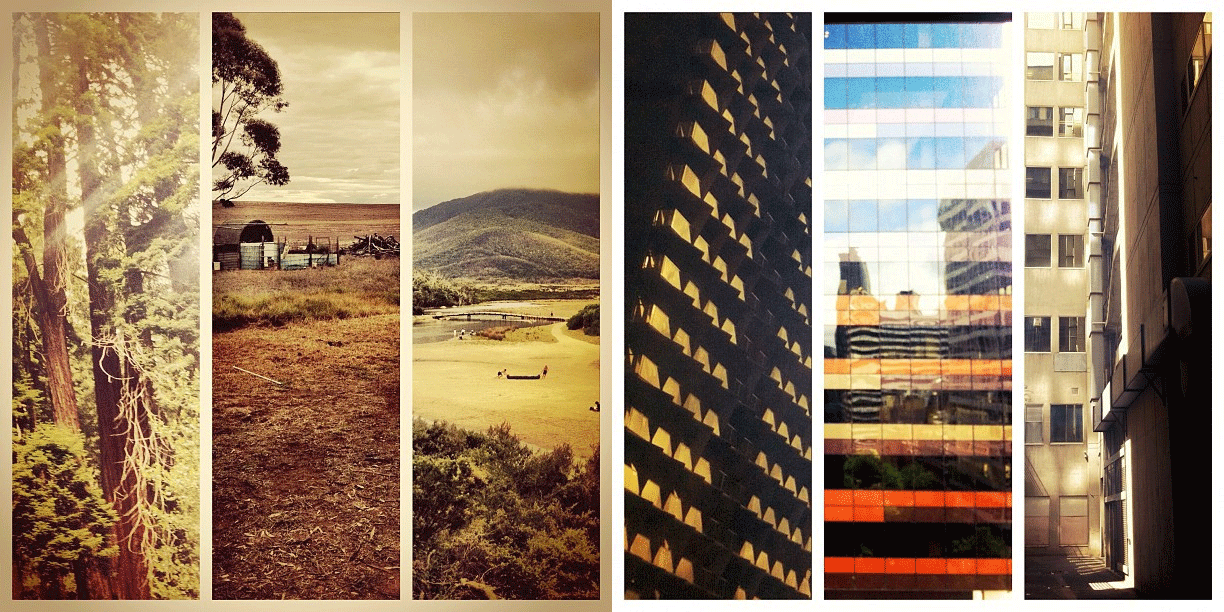
People have connections to them; they influence us as much as we influence them.
People have connections to them; they influence us as much as we influence them.
Parks Victoria have produced a video on Aboriginal Cultural knowledge, a great introduction to the notion that people, practices and a landscape are tightly related.
People say that after they have been in an area for a while, they start to become a reflection of that environment. Sometimes, the environment starts to reflect the people. This connection between people and country is what powers the life essence and intrinsic memory imprinted in that place. It is this absorbed energy that continues to draw people there, for the same reasons, for countless generations.
My case study site is Wilson’s Promontory, a national park situated in the rural south east of Victoria, Australia. Whilst my thesis will broadly discuss the roll of environmental understanding (from a cultural geography perspective) in the design of technology for use in these types of settings, the “practical problem” I’m faced with is to make something for the park and it’s rangers. As an exercise it’s worth thinking about the space of the park as a context for design, exploring the implications this may have and distilling what aspects of this environment might be meaningful for design.
Most technology is designed for urban contexts, by designers with urban perspectives. As Bidwell & Browning (2010) explain, this monocultural approach to technology can lead to significant amounts of dissonance when it comes to use in rural settings. Screen glare is a common example of technology going fundamentally wrong in a natural setting – but other examples, such as the unsuitability of social networks for rural lifestyles, have also been explored. It’s important to challenge assumptions about traditional (i.e. urban) design approaches when moving away from cities and into natural and rural settings.
So, as a starting point it’s important to define what a “natural place” is. Bidwell & Browning give an definition based on two criteria: population density, and access to infrastructure. A natural environment, according to them, is sparse in human population and has limited built infrastructure. The park is an interesting landscape in this regard, because it has a combination of “urban” settings along with completely unpopulated, infrastructure sparse locations.
So, on the one hand we have a tightly “cultivated” area of the park – those most frequented by tourists, and heavy on built infrastructure. On the other, we have a largely preserved or “uncultivated” areas – where built infrastructure is extremely limited. It is at once a “natural place” – as defined by Bidwell & Browning – but also a tourist space, where populations fluctuate and infrastructure is at least as developed as in surrounding town centres. All the while, the digital infrastructure is not discriminating – cellular towers provide adequate coverage to most human-accessible areas.
Given this dichotomy of populations and infrastructure, it’s difficult to classify the park as either a “natural place” or an “urban environment”. It has elements of both, but it is truly neither. Is it right to call somewhere a “natural place” if you’ve got full reception on your iPhone? If it’s a particularly busy day, with many thousands of people in the park, do we suddenly call it “urban”, despite being surrounded by native flora and fauna?
Given the difficulty in classifying the park as either “natural” or “urban”, it’s worth examining the park as a set of different geographies that are not in competition with one another, but are complimentary perspectives that emerge through interactions between and by people (particularly, rangers) in the park. The previous two posts have begun to address varieties of these perspectives – how the movement and flows of rangers construct a particular perspective of the park space, and how the geography of infrastructure might act as an index to the knowable areas of the park.
Some further “geographies” that seem to be coming out of interviews and diary entries speak to the follow categories:
Personal geographies is a term I’ve been using in (thus far private) writing and preliminary analysis of diary studies and interviews I’ve conducted with park rangers. The above picture is the result of combining a particular kind of personal geography – jogging trails through New York city. It’s also an increasingly common type of visualisation; the visualisation of movement to emerge the shape of a space. Twitter heat maps and flickr overlays are also in vogue (not that that’s a bad thing!). The best thing about personal geographies is that, when combined, they form social geographies; the sense of place that has arisen through a community’s interaction with the city. What the visualisation above shows is a particular interpretation of a place, and one that was not necessarily deliberate.
This is also another example of digital data imposing itself on the physical world – it’s becoming increasingly easy to access the data in the digital layer above us. The seams between digital and physical are blurring too; as this example shows, our physical being in the world increasingly generates digital data, without consciously creating “content”. Conversely, the act of deliberate “generation” of content can influence our physical space and the actions we take in them. At the most basic level, think foursquare check-ins influencing which bar you go to.
We’re already living in a hybrid physical/digital world – and they’re increasingly influencing each other in ways designed or not. In fact, the duality of physical and digital may be a generational divide – in 100 years (less?), it will most likely sound comical to separate the two.
Link: Drawing New York
Following on from the recent city/space theme is a new exhibition at Tokyo’s Mori Art gallery in Roppongi Hills entitled “Metabolism”.
Metabolism is an architecture movement that started in Japan in the 1960s. From the press release:
Metabolism which sprang up in the 1960s remains the most widely known modern architecture movement to have emerged from Japan. As its biological name suggests, the movement contends that buildings
and cities should be designed in the same continuous way that the material substance of a natural organism is produced. This is the ï¬rst exhibition in the world to provide such a comprehensive overview of the movement.Models, archive film footage, and 3D computer graphic images of grand visions of future cities held by the architect
Tange Kenzo, as well as Kurokawa Kisho, Kikutake Kiyonori, and others who had come under the influence of Tange, and their experimental architecture which has become a reality in today’s cities, will be exhibited for exploration of their meaning from a current perspective.
It looks like it’ll provide some great insight into how the future was imagined, in the past. It would be interesting to see how (if at all) the digital world was thought of when designing this then new type of Urbanism.
The exhibition runs from July through to August, 2011. If you happen to be in the neighbourhood you should definitely check it out.